Ch. 15 - Innate Immunity
Bauman - Microbiology with Diseases by Taxonomy 6th Edition
Bauman6th EditionMicrobiology with Diseases by TaxonomyISBN: 9780134832302당신이 사용하는 게 아니라요?교과서 변경
15장, 문제 5

Describe the classical complement cascade pathway from C1 to the MAC.

검증된 단계별 안내
1
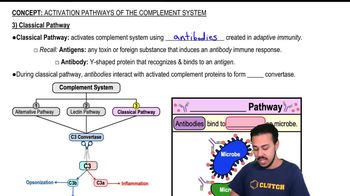
Begin by explaining that the classical complement pathway is initiated when the C1 complex binds to antibodies (IgG or IgM) that are attached to antigens on the surface of a pathogen.
Describe that the C1 complex is composed of C1q, C1r, and C1s subunits; upon binding, C1r activates C1s, which then cleaves C4 into C4a and C4b, and C2 into C2a and C2b.
Explain that C4b and C2a combine to form the C3 convertase (C4b2a), which cleaves C3 into C3a and C3b; C3b then binds to the C3 convertase to form the C5 convertase (C4b2a3b).
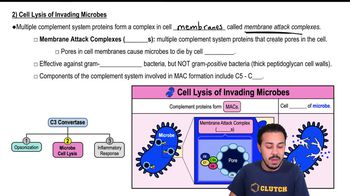
Detail that the C5 convertase cleaves C5 into C5a and C5b; C5b initiates the assembly of the membrane attack complex (MAC) by sequentially binding C6, C7, C8, and multiple C9 molecules.
Conclude by describing that the MAC forms a pore in the pathogen's membrane, leading to cell lysis and death, thus completing the classical complement cascade.

비슷한 문제에 대한 검증된 영상 답변:

이 영상 해법은 위 문제에 도움이 된다고 튜터들이 추천한 것입니다.
영상 길이:
1m
도움이 되었나요?

주요 개념

질문에 올바르게 답하기 위해 반드시 이해해야 하는 핵심 개념들은 다음과 같습니다.

Classical Complement Pathway Initiation

The classical pathway begins when the C1 complex (composed of C1q, C1r, and C1s) binds to antibodies attached to antigens on a pathogen surface. This binding activates C1r and C1s, which then cleave the next components, C4 and C2, initiating the cascade.
추천 영상:
가이드 코스
03:42
3) Classical Pathway

Formation of C3 Convertase and C5 Convertase

Activated C4b and C2a combine to form the C3 convertase (C4b2a), which cleaves C3 into C3a and C3b. C3b binds to C3 convertase to form C5 convertase (C4b2a3b), which cleaves C5 into C5a and C5b, progressing the cascade toward membrane attack complex formation.
추천 영상:
가이드 코스
03:18
2) Cell Lysis of Invading Microbes

Membrane Attack Complex (MAC) Assembly

C5b initiates MAC formation by sequentially binding C6, C7, C8, and multiple C9 molecules. This complex inserts into the pathogen membrane, creating pores that disrupt membrane integrity, leading to cell lysis and death.
추천 영상: