
Ch. 15 - Innate Immunity
Bauman - Microbiology with Diseases by Taxonomy 6th Edition
Bauman6th EditionMicrobiology with Diseases by TaxonomyISBN: 9780134832302당신이 사용하는 게 아니라요?교과서 변경
15장, 문제 2

How does a phagocyte “know” it is in contact with a pathogen instead of another body cell?

검증된 단계별 안내
1
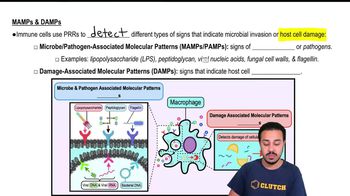
Understand that phagocytes recognize pathogens through specific molecular patterns called Pathogen-Associated Molecular Patterns (PAMPs), which are unique to microbes and not found on host cells.
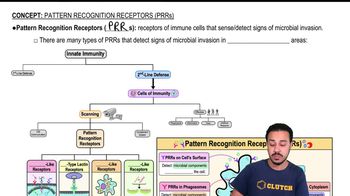
Learn that phagocytes have specialized receptors on their surface called Pattern Recognition Receptors (PRRs), such as Toll-like receptors (TLRs), which bind specifically to PAMPs.
When a phagocyte encounters a cell, it uses its PRRs to scan the surface molecules; if PAMPs are detected, the phagocyte identifies the cell as a pathogen.
Recognize that host cells display 'self' markers, such as Major Histocompatibility Complex (MHC) molecules, which help phagocytes distinguish them from pathogens and avoid attacking the body's own cells.
Summarize that the interaction between PRRs on phagocytes and PAMPs on pathogens is the key mechanism by which phagocytes 'know' they are in contact with a pathogen rather than a normal body cell.

비슷한 문제에 대한 검증된 영상 답변:

이 영상 해법은 위 문제에 도움이 된다고 튜터들이 추천한 것입니다.
영상 길이:
2m
도움이 되었나요?

주요 개념

질문에 올바르게 답하기 위해 반드시 이해해야 하는 핵심 개념들은 다음과 같습니다.

Pathogen-Associated Molecular Patterns (PAMPs)

PAMPs are unique molecular structures found on pathogens but not on host cells. Phagocytes recognize these conserved patterns, such as lipopolysaccharides on bacteria, enabling them to distinguish harmful microbes from the body’s own cells.
추천 영상:

Pattern Recognition Receptors (PRRs)

PRRs are specialized receptors on phagocytes that detect PAMPs. By binding to these molecular patterns, PRRs trigger the phagocyte to initiate an immune response, ensuring selective targeting of pathogens rather than normal body cells.
추천 영상:
가이드 코스
04:24
Pattern Recognition Receptors

Self vs. Non-Self Discrimination

Phagocytes use molecular markers to differentiate self cells from foreign invaders. The absence of self markers and presence of PAMPs on pathogens guide phagocytes to identify and engulf harmful microbes while sparing the body’s own cells.
추천 영상:
가이드 코스
02:06
Cyclic vs. Non-Cyclic Photophosphorylation
관련 실천
교과서 질문

Write the letter of the description that applies to each of the following terms:

1. ___ Goblet cell

2. ___ Lysozyme

3. ___ Stem cell

4. ___ Dendritic cell

5. ___ Cell from sebaceous gland

6. ___ Bone marrow stem cell

7. ___ Eosinophil

8. ___ Alveolar macrophage

9. ___ Microglia

10. ___ Wandering macrophage

A. Leukocyte that primarily attacks parasitic worms

B. Phagocytic cell in lungs

C. Secretes sebum

D. Devours pathogens in epidermis

E. Breaks bonds in bacterial cell wall

F. Phagocytic cell in central nervous system

G. Generative cell with many types of offspring

H. Develops into formed elements of blood

I. Intercellular scavenger

J. Secretes mucus

1350
views
교과서 질문

The complement system involves:

a. The production of antigens and antibodies

b. Serum proteins involved in nonspecific defense

c. A set of genes that distinguish foreign cells from body cells

d. The elimination of undigested remnants of microorganisms

1511
views
교과서 질문

Identify the type of hypersensitivity reaction in each photo.

<IMAGE>

1903
views
교과서 질문

Indicate which statements are true. Correct all false statements by changing the underlined words.

__________ The surface cells of mucous membranes are alive.

599
views
교과서 질문

Mucus-secreting membranes are found in:

a. The urinary system

b. The digestive cavity

c. The respiratory passages

d. All of the above

830
views
교과서 질문

Indicate which statements are true. Correct all false statements by changing the underlined words.

__________ Wandering macrophages experience diapedesis.

772
views