Ch. 3 - Cell Structure and Function
Bauman - Microbiology with Diseases by Taxonomy 6th Edition
Bauman6th EditionMicrobiology with Diseases by TaxonomyISBN: 9780134832302당신이 사용하는 게 아니라요?교과서 변경
3장, 문제 16

Contrast the following active processes for transporting materials into or out of a cell: active transport, group translocation, endocytosis, exocytosis.

검증된 단계별 안내
1
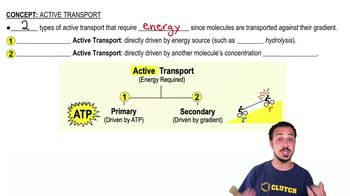
Begin by defining active transport: it is a process where molecules move across a cell membrane from a region of lower concentration to a higher concentration using energy, typically from ATP. This process involves specific carrier proteins or pumps.
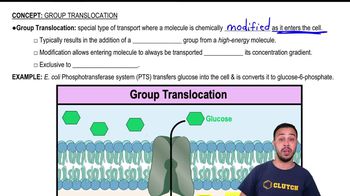
Next, explain group translocation: this is a specialized form of active transport found mainly in prokaryotes, where the transported substance is chemically modified during its passage across the membrane, which helps retain it inside the cell and often uses phosphoenolpyruvate (PEP) as an energy source.
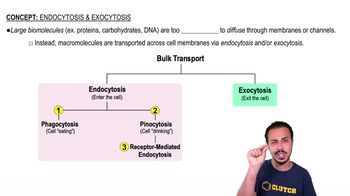
Then, describe endocytosis: a process used by eukaryotic cells to engulf large particles or fluids by enclosing them in a vesicle formed from the plasma membrane, allowing materials to enter the cell. This process requires energy and includes types like phagocytosis and pinocytosis.
After that, outline exocytosis: the reverse of endocytosis, where materials contained in vesicles inside the cell are expelled to the outside by fusion of the vesicle with the plasma membrane, also an energy-dependent process.
Finally, contrast these processes by highlighting that active transport and group translocation move molecules across membranes often against concentration gradients using energy, with group translocation chemically modifying the molecule, while endocytosis and exocytosis involve vesicle formation to transport larger substances or bulk materials into or out of the cell.

비슷한 문제에 대한 검증된 영상 답변:

이 영상 해법은 위 문제에 도움이 된다고 튜터들이 추천한 것입니다.
영상 길이:
3m
도움이 되었나요?

주요 개념

질문에 올바르게 답하기 위해 반드시 이해해야 하는 핵심 개념들은 다음과 같습니다.

Active Transport

Active transport is the movement of molecules across a cell membrane against their concentration gradient, using energy typically from ATP. It involves specific carrier proteins or pumps that help import or export substances essential for cell function.
추천 영상:
가이드 코스
02:37
Active Transport

Group Translocation

Group translocation is a specialized form of active transport where the transported molecule is chemically modified during its passage into the cell. This process, common in bacteria, uses energy to both move and alter the substrate, preventing it from diffusing back out.
추천 영상:
가이드 코스
03:37
Group Translocation

Endocytosis and Exocytosis

Endocytosis and exocytosis are bulk transport processes where cells engulf materials into vesicles (endocytosis) or expel substances by vesicle fusion with the membrane (exocytosis). Both require energy and are vital for large molecules or particles that cannot pass through membranes by other means.
추천 영상:
가이드 코스
02:02
Endocytosis and Exocytosis