Ch. 3 - Cell Structure and Function
Bauman - Microbiology with Diseases by Taxonomy 6th Edition
Bauman6th EditionMicrobiology with Diseases by TaxonomyISBN: 9780134832302당신이 사용하는 게 아니라요?교과서 변경
3장, 문제 18

Describe the endosymbiotic theory. What evidence supports the theory? Which features of eukaryotic cells are not explained by the theory?

검증된 단계별 안내
1
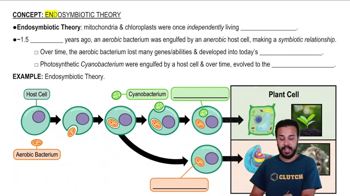
Begin by defining the endosymbiotic theory: it proposes that certain organelles in eukaryotic cells, such as mitochondria and chloroplasts, originated from free-living prokaryotic cells that were engulfed by ancestral eukaryotic cells, forming a symbiotic relationship.
Explain the key evidence supporting the theory, including: (a) mitochondria and chloroplasts have their own circular DNA similar to prokaryotes; (b) these organelles have double membranes consistent with engulfment; (c) they reproduce independently within the cell by a process similar to binary fission; (d) their ribosomes resemble those of prokaryotes in size and sensitivity to antibiotics.
Discuss how molecular evidence, such as similarities in gene sequences between mitochondrial/chloroplast DNA and certain bacteria, further supports the theory.
Identify features of eukaryotic cells that the endosymbiotic theory does not fully explain, such as the origin of the nucleus, the endomembrane system (including the Golgi apparatus and endoplasmic reticulum), and the cytoskeleton.
Summarize by noting that while the endosymbiotic theory explains the origin of some organelles, it is part of a broader understanding of eukaryotic cell evolution that involves multiple processes.

비슷한 문제에 대한 검증된 영상 답변:

이 영상 해법은 위 문제에 도움이 된다고 튜터들이 추천한 것입니다.
영상 길이:
3m
도움이 되었나요?

주요 개념

질문에 올바르게 답하기 위해 반드시 이해해야 하는 핵심 개념들은 다음과 같습니다.

Endosymbiotic Theory

The endosymbiotic theory proposes that certain organelles in eukaryotic cells, such as mitochondria and chloroplasts, originated from free-living prokaryotes that were engulfed by ancestral host cells. This symbiotic relationship became permanent, leading to the evolution of complex eukaryotic cells.
추천 영상:
가이드 코스
06:58
Endosymbiotic Theory

Evidence Supporting Endosymbiotic Theory

Evidence includes the presence of double membranes around mitochondria and chloroplasts, their own circular DNA similar to bacteria, and their ability to replicate independently within the cell. Additionally, these organelles have ribosomes resembling those of prokaryotes, supporting their bacterial origin.
추천 영상:
가이드 코스
06:58
Endosymbiotic Theory

Limitations of the Endosymbiotic Theory

While the theory explains the origin of mitochondria and chloroplasts, it does not account for other eukaryotic features like the nucleus, endoplasmic reticulum, or cytoskeleton. These structures likely evolved through different mechanisms, indicating the theory covers only part of eukaryotic cell evolution.
추천 영상:
가이드 코스
06:58
Endosymbiotic Theory