Ch. 3 - Cell Structure and Function
Bauman - Microbiology with Diseases by Taxonomy 6th Edition
Bauman6th EditionMicrobiology with Diseases by TaxonomyISBN: 9780134832302당신이 사용하는 게 아니라요?교과서 변경
3장, 문제 9

Differentiate among pili, fimbriae, and cilia, using sketches and descriptive labels.

검증된 단계별 안내
1
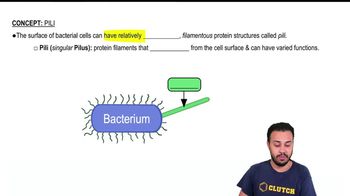
Step 1: Understand the basic definitions of each structure. Pili and fimbriae are hair-like appendages found on the surface of bacterial cells, while cilia are hair-like structures found on eukaryotic cells.
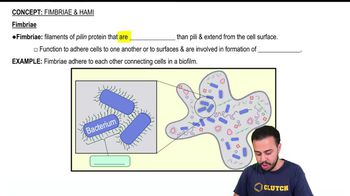
Step 2: Describe fimbriae as short, thin, and numerous projections primarily used for attachment to surfaces or other cells. They are typically shorter than pili and do not play a role in motility.
Step 3: Describe pili as longer than fimbriae but fewer in number. Pili are involved in processes such as conjugation (transfer of genetic material between bacteria) and sometimes motility (twitching movement).
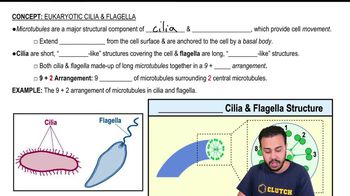
Step 4: Describe cilia as eukaryotic cell structures that are longer and more complex than pili and fimbriae. Cilia are usually present in large numbers and beat rhythmically to move the cell or move fluid over the cell surface.
Step 5: Sketch each structure with labels: draw fimbriae as many short bristle-like projections, pili as fewer and longer hair-like structures, and cilia as numerous, longer, and more complex projections with a characteristic 9+2 microtubule arrangement inside (if detail is required).

비슷한 문제에 대한 검증된 영상 답변:

이 영상 해법은 위 문제에 도움이 된다고 튜터들이 추천한 것입니다.
영상 길이:
1m
도움이 되었나요?

주요 개념

질문에 올바르게 답하기 위해 반드시 이해해야 하는 핵심 개념들은 다음과 같습니다.

Pili

Pili are hair-like appendages found on the surface of many bacteria, primarily involved in attachment to surfaces and in conjugation, where they facilitate DNA transfer between cells. They are typically longer and fewer in number compared to fimbriae.
추천 영상:

Fimbriae

Fimbriae are short, thin, and numerous proteinaceous projections on bacterial cells that enable adhesion to host tissues or surfaces, playing a key role in colonization and infection. Unlike pili, fimbriae are not involved in genetic exchange.
추천 영상:
가이드 코스
01:52
Fimbriae & Hami

Cilia

Cilia are eukaryotic cell surface structures composed of microtubules arranged in a 9+2 pattern, used for locomotion or moving fluids across the cell surface. They are structurally and functionally distinct from bacterial pili and fimbriae.
추천 영상:
가이드 코스
02:36
Eukaryotic Cilia & Flagella