Ch. 3 - Cell Structure and Function
Bauman - Microbiology with Diseases by Taxonomy 6th Edition
Bauman6th EditionMicrobiology with Diseases by TaxonomyISBN: 9780134832302당신이 사용하는 게 아니라요?교과서 변경
3장, 문제 8

Which of the following is not a function of a glycocalyx?


a. It forms pseudopods for faster mobility of an organism.
b. It can protect a bacterial cell from drying out.
c. It hides a bacterial cell from other cells.
d. It allows a bacterium to stick to a host.

검증된 단계별 안내
1
Step 1: Understand what a glycocalyx is. The glycocalyx is a gelatinous, sticky substance surrounding the outside of some bacterial cells, composed mainly of polysaccharides and sometimes proteins.
Step 2: Review the known functions of the glycocalyx. It helps bacteria adhere to surfaces (including host tissues), protects against desiccation (drying out), and can help evade the host immune system by hiding the bacterial cell.
Step 3: Analyze each option in the question: Option a suggests the glycocalyx forms pseudopods for mobility, which is a function typically associated with eukaryotic cells, not bacteria or their glycocalyx.
Step 4: Compare the other options (b, c, d) with known functions of the glycocalyx. These options align with its protective and adhesive roles.
Step 5: Conclude that the function not associated with the glycocalyx is forming pseudopods for faster mobility, as this is unrelated to the glycocalyx structure or function.

비슷한 문제에 대한 검증된 영상 답변:

이 영상 해법은 위 문제에 도움이 된다고 튜터들이 추천한 것입니다.
영상 길이:
2m
도움이 되었나요?

주요 개념

질문에 올바르게 답하기 위해 반드시 이해해야 하는 핵심 개념들은 다음과 같습니다.

Glycocalyx Structure and Function

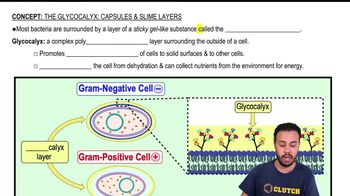
The glycocalyx is a sticky, gelatinous layer surrounding some bacterial cells, composed mainly of polysaccharides. It serves to protect the cell from desiccation, helps bacteria adhere to surfaces, and can shield them from immune detection by hiding antigenic sites.
추천 영상:
가이드 코스
02:26
The Glycocalyx: Capsules & Slime Layers

Bacterial Motility Mechanisms

Bacteria move using structures like flagella or by gliding, but not by forming pseudopods. Pseudopods are extensions of the cytoplasm used by some eukaryotic cells, such as amoebae, for movement and engulfing particles, which is unrelated to bacterial glycocalyx.
추천 영상:
가이드 코스
03:49
Mechanism of Natural Transformation

Role of Glycocalyx in Immune Evasion and Adhesion

The glycocalyx can mask bacterial surface antigens, helping evade host immune responses. It also facilitates adhesion to host tissues, which is critical for colonization and infection, making it a key factor in bacterial pathogenicity.
추천 영상:
가이드 코스
02:26
The Glycocalyx: Capsules & Slime Layers