Ch. 4 - Microscopy, Staining, and Classification
Bauman - Microbiology with Diseases by Taxonomy 6th Edition
Bauman6th EditionMicrobiology with Diseases by TaxonomyISBN: 9780134832302당신이 사용하는 게 아니라요?교과서 변경
4장, 문제 8

An atomic force microscope can magnify a living cell, whereas electron microscopes and scanning tunneling microscopes cannot. What requirement of scanning tunneling microscopes precludes the imaging of living specimens?

검증된 단계별 안내
1
Understand the principle of how a scanning tunneling microscope (STM) works: it relies on the quantum tunneling of electrons between a conductive tip and the specimen surface when they are extremely close.
Recognize that for STM to function, the specimen must be electrically conductive or at least semiconductive to allow the tunneling current to flow.
Consider the nature of living cells, which are generally non-conductive or poorly conductive due to their composition (mostly water and organic molecules).
Realize that because living cells do not provide the necessary conductive surface, the STM cannot generate the tunneling current required to form an image.
Conclude that the requirement of electrical conductivity in the specimen is what precludes the imaging of living specimens by scanning tunneling microscopes.

비슷한 문제에 대한 검증된 영상 답변:

이 영상 해법은 위 문제에 도움이 된다고 튜터들이 추천한 것입니다.
영상 길이:
3m
도움이 되었나요?

주요 개념

질문에 올바르게 답하기 위해 반드시 이해해야 하는 핵심 개념들은 다음과 같습니다.

Principle of Scanning Tunneling Microscopy (STM)

STM operates by measuring the tunneling current between a conductive tip and the specimen's surface, requiring the sample to be electrically conductive or semiconductive. This principle limits STM to imaging conductive materials and excludes non-conductive or living biological specimens.
추천 영상:
가이드 코스
02:54
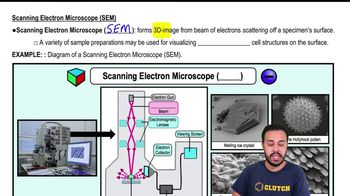
Scanning Electron Microscope (SEM)

Sample Requirements for STM Imaging

For STM to function, the specimen must be placed in an ultra-high vacuum or controlled environment and be stable and conductive. Living cells, which are non-conductive and require aqueous environments, cannot meet these conditions, preventing their imaging by STM.
추천 영상:
가이드 코스
03:52
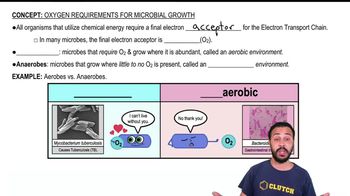
Oxygen Requirements for Microbial Growth

Differences Between Atomic Force Microscopy and STM

Atomic force microscopy (AFM) uses a mechanical probe to scan surfaces and does not require electrical conductivity, allowing imaging of living cells in physiological conditions. In contrast, STM relies on electron tunneling, restricting it to conductive, non-living samples.
추천 영상:
가이드 코스
05:32
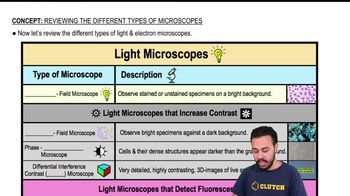
Reviewing the Different Types of Microscopes