Ch. 4 - Microscopy, Staining, and Classification
Bauman - Microbiology with Diseases by Taxonomy 6th Edition
Bauman6th EditionMicrobiology with Diseases by TaxonomyISBN: 9780134832302당신이 사용하는 게 아니라요?교과서 변경
4장, 문제 9

Negative stains such as eosin are also called _______.
a. Capsule stains
b. Endospore stains
c. Simple stains
d. Acid-fast stains

검증된 단계별 안내
1
Understand what a negative stain is: Negative staining involves staining the background instead of the microorganism itself, which leaves the cells clear and visible against a dark background.
Recall the purpose of eosin in staining: Eosin is an acidic dye that carries a negative charge and is repelled by the negatively charged bacterial cell surface, so it stains the background rather than the cells.
Identify the category of stains that work by staining the background and not the cells: These are called acidic stains or negative stains.
Match the options given with the type of stain eosin represents: Capsule stains highlight capsules, endospore stains highlight spores, simple stains color all cells uniformly, and acid-fast stains target mycolic acid in cell walls.
Conclude that negative stains such as eosin are also called acidic stains or negative stains, which is not explicitly listed but aligns best with the concept of staining the background rather than the cells.

비슷한 문제에 대한 검증된 영상 답변:

이 영상 해법은 위 문제에 도움이 된다고 튜터들이 추천한 것입니다.
영상 길이:
2m
도움이 되었나요?

주요 개념

질문에 올바르게 답하기 위해 반드시 이해해야 하는 핵심 개념들은 다음과 같습니다.

Negative Staining

Negative staining is a technique where the background, rather than the microorganism, is stained. This creates a contrast that makes the cells appear clear against a dark background, useful for observing cell shape and size without heat-fixing.
추천 영상:

Eosin as a Negative Stain

Eosin is an acidic dye that carries a negative charge, repelling the negatively charged bacterial cell surface. This property causes eosin to stain the background instead of the cells, classifying it as a negative stain.
추천 영상:

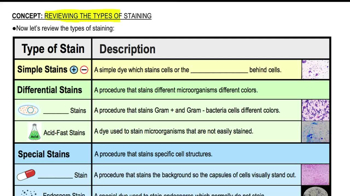
Types of Stains in Microbiology

Microbiological stains include simple stains (which color cells directly), differential stains (which distinguish cell types), and special stains like capsule, endospore, and acid-fast stains. Negative stains are a special category that stain the background, not the cells.
추천 영상:
가이드 코스
04:11
Reviewing the Types of Staining