Ch. 9 - Controlling Microbial Growth in the Environment
Bauman - Microbiology with Diseases by Taxonomy 6th Edition
Bauman6th EditionMicrobiology with Diseases by TaxonomyISBN: 9780134832302당신이 사용하는 게 아니라요?교과서 변경
9장, 문제 5

Why are Gram-negative bacteria more susceptible to heat than Gram-positive bacteria?

검증된 단계별 안내
1
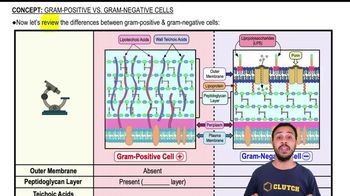
Understand the structural differences between Gram-positive and Gram-negative bacteria, focusing on their cell wall composition.
Recall that Gram-positive bacteria have a thick peptidoglycan layer, which provides rigidity and protection against environmental stresses such as heat.
Note that Gram-negative bacteria have a thinner peptidoglycan layer but possess an outer membrane containing lipopolysaccharides, which is less protective against heat.
Analyze how the thick peptidoglycan layer in Gram-positive bacteria acts as a thermal barrier, helping to maintain cell integrity under heat stress.
Conclude that the thinner peptidoglycan layer and the presence of the outer membrane in Gram-negative bacteria make them more vulnerable to heat-induced damage, leading to higher susceptibility.

비슷한 문제에 대한 검증된 영상 답변:

이 영상 해법은 위 문제에 도움이 된다고 튜터들이 추천한 것입니다.
영상 길이:
2m
도움이 되었나요?

주요 개념

질문에 올바르게 답하기 위해 반드시 이해해야 하는 핵심 개념들은 다음과 같습니다.

Cell Wall Structure of Gram-Positive and Gram-Negative Bacteria

Gram-positive bacteria have a thick peptidoglycan layer that provides structural strength and protection, while Gram-negative bacteria have a thinner peptidoglycan layer and an outer membrane. This difference affects their resilience to environmental stresses like heat.
추천 영상:
04:46
Gram-Positive vs. Gram-Negative Cell Walls

Role of the Outer Membrane in Gram-Negative Bacteria

The outer membrane of Gram-negative bacteria contains lipopolysaccharides and acts as a barrier to certain substances, but it is more sensitive to heat damage. Heat can disrupt this membrane, making Gram-negative bacteria more vulnerable compared to Gram-positive bacteria.
추천 영상:
02:15
The Outer Membrane

Heat Denaturation of Proteins and Membrane Integrity

Heat causes proteins to denature and membranes to lose integrity, leading to cell death. Since Gram-negative bacteria have a more complex and delicate outer membrane, heat-induced damage compromises their survival more readily than the robust cell wall of Gram-positive bacteria.
추천 영상:
04:00
Denatured Proteins & Chaperones