Ch. 4 - Introduction to Eukaryotic Cells
Norman-McKay- Microbiology: Basic and Clinical Principles 2nd Edition
Norman-McKay2nd EditionMicrobiology: Basic and Clinical PrinciplesISBN: 9780137661619당신이 사용하는 게 아니라요?교과서 변경
2장, 문제 10

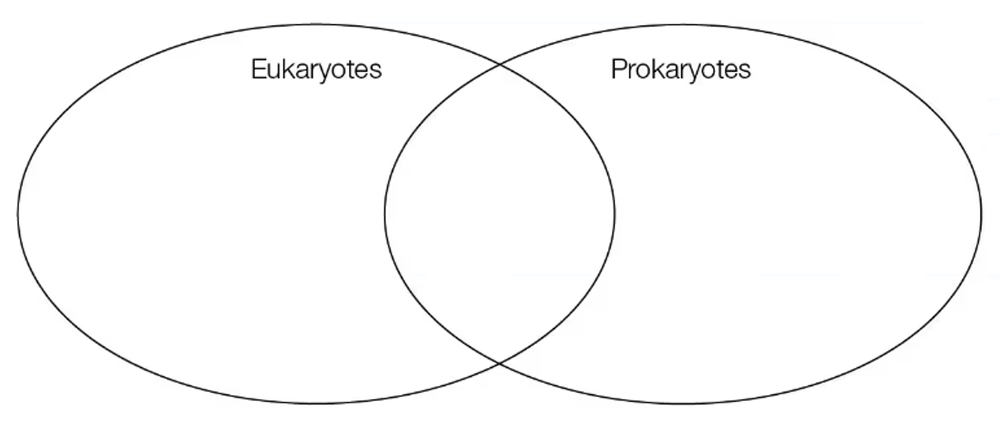
Complete the Venn diagram that compares and contrasts prokaryotes and eukaryotes.
Blank Venn diagram with two overlapping circles labeled Eukaryotes and Prokaryotes for comparing cell characteristics.

검증된 단계별 안내
1
Identify the defining characteristics of prokaryotes, such as the absence of a nucleus, presence of a single circular chromosome, lack of membrane-bound organelles, and generally smaller cell size.
List the defining characteristics of eukaryotes, including the presence of a true nucleus, multiple linear chromosomes, membrane-bound organelles like mitochondria and the endoplasmic reticulum, and generally larger cell size.
Determine the shared features between prokaryotes and eukaryotes, such as having a plasma membrane, ribosomes for protein synthesis, DNA as genetic material, and the ability to carry out basic metabolic processes.
Organize these characteristics into the Venn diagram by placing unique prokaryotic traits in the prokaryote-only section, unique eukaryotic traits in the eukaryote-only section, and shared traits in the overlapping middle section.
Review the completed Venn diagram to ensure all key similarities and differences are accurately represented, helping to visualize the fundamental distinctions and commonalities between these two cell types.

비슷한 문제에 대한 검증된 영상 답변:

이 영상 해법은 위 문제에 도움이 된다고 튜터들이 추천한 것입니다.
영상 길이:
2m
도움이 되었나요?

주요 개념

질문에 올바르게 답하기 위해 반드시 이해해야 하는 핵심 개념들은 다음과 같습니다.

Cellular Structure of Prokaryotes and Eukaryotes

Prokaryotes are unicellular organisms without a nucleus or membrane-bound organelles, while eukaryotes have a defined nucleus and various organelles. Understanding these structural differences is essential for comparing their cellular organization.
추천 영상:
05:54
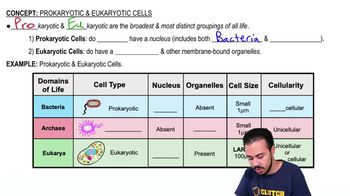
Prokaryotic & Eukaryotic Cells

Genetic Material Organization

In prokaryotes, DNA is typically circular and located in the nucleoid region, whereas eukaryotic DNA is linear and enclosed within the nucleus. This distinction affects gene expression and replication processes.
추천 영상:
01:28
Genetic Code

Reproduction and Metabolic Diversity

Prokaryotes reproduce mainly by binary fission and exhibit diverse metabolic pathways, including anaerobic and photosynthetic processes. Eukaryotes reproduce sexually or asexually and have more complex metabolic systems, which is important for understanding their biological roles.
추천 영상:
02:17
Introduction to Metabolism