Ch. 4 - Introduction to Eukaryotic Cells
Norman-McKay- Microbiology: Basic and Clinical Principles 2nd Edition
Norman-McKay2nd EditionMicrobiology: Basic and Clinical PrinciplesISBN: 9780137661619당신이 사용하는 게 아니라요?교과서 변경
2장, 문제 13

Eukaryotic flagella differ from prokaryotic flagella in that:
a. Eukaryotic flagella use a rotary motion to propel the cell.
b. Eukaryotic flagella are made of proteins.
c. Eukaryotic flagella are not enclosed in a membrane.
d. Eukaryotic flagella have a 9 +2 arrangement of microtubules.

검증된 단계별 안내
1
Step 1: Understand the structural differences between eukaryotic and prokaryotic flagella. Eukaryotic flagella are complex organelles enclosed by the cell membrane, while prokaryotic flagella are simpler and not membrane-bound.
Step 2: Recall the motion mechanism. Prokaryotic flagella rotate like a propeller to move the cell, whereas eukaryotic flagella move with a whip-like or undulating motion.
Step 3: Consider the composition. Both types of flagella are made of proteins, but the specific proteins differ. Eukaryotic flagella are primarily composed of microtubules arranged in a characteristic pattern.
Step 4: Focus on the microtubule arrangement in eukaryotic flagella. They have a '9 + 2' arrangement, meaning nine pairs of microtubules form a ring around two central microtubules.
Step 5: Use this information to evaluate each option: (a) relates to motion type, (b) relates to composition, (c) relates to membrane presence, and (d) relates to microtubule structure. Identify which statement correctly describes eukaryotic flagella.

비슷한 문제에 대한 검증된 영상 답변:

이 영상 해법은 위 문제에 도움이 된다고 튜터들이 추천한 것입니다.
영상 길이:
1m
도움이 되었나요?

주요 개념

질문에 올바르게 답하기 위해 반드시 이해해야 하는 핵심 개념들은 다음과 같습니다.

Structure of Eukaryotic Flagella

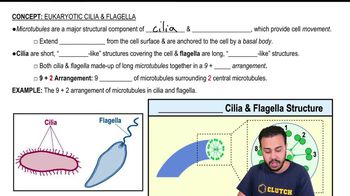
Eukaryotic flagella are complex organelles composed of microtubules arranged in a characteristic 9 + 2 pattern, meaning nine pairs of microtubules surround two central microtubules. This structure is enclosed by the cell membrane and is essential for their whip-like motion.
추천 영상:
가이드 코스
02:36
Eukaryotic Cilia & Flagella

Structure of Prokaryotic Flagella

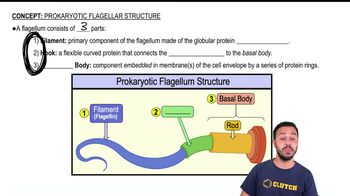
Prokaryotic flagella are simpler, made primarily of the protein flagellin, and lack microtubules. They are not enclosed by the cell membrane and function through a rotary motor mechanism embedded in the cell envelope, enabling a spinning motion to propel the cell.
추천 영상:
가이드 코스
02:53
Prokaryotic Flagellar Structure

Mechanism of Flagellar Movement

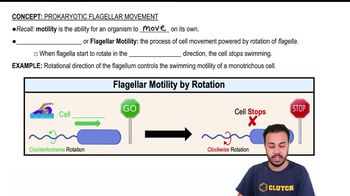
Eukaryotic flagella move by bending in a whip-like fashion powered by dynein motor proteins sliding microtubules against each other. In contrast, prokaryotic flagella rotate like a propeller, driven by a rotary motor using proton motive force, resulting in different modes of cell propulsion.
추천 영상:
가이드 코스
02:43
Prokaryotic Flagellar Movement