Ch. 15 - Microbial Mechanisms of Pathogenicity
Tortora - Microbiology: An Introduction 14th Edition
Tortora14th EditionMicrobiology: An IntroductionISBN: 9780138200398당신이 사용하는 게 아니라요?교과서 변경
11장, 문제 9

Which of the following does not represent the same mechanism for avoiding host defenses as the others?
a. Rabies virus attaches to the receptor for the neurotransmitter acetylcholine.
b. Salmonella attaches to the receptor for epidermal growth factor.
c. Lymphocryptovirus (mononucleosis) virus binds to the host receptor for complement protein.
d. Surface protein genes in N. gonorrhoeae mutate frequently.
e. none of the above

검증된 단계별 안내
1
Step 1: Understand the question is asking which option does NOT represent the same mechanism for avoiding host defenses as the others. This means we need to identify the common mechanism shared by most options and find the one that differs.
Step 2: Analyze options a, b, and c. Each describes a pathogen attaching to a specific host receptor (acetylcholine receptor, epidermal growth factor receptor, complement protein receptor). This attachment to host receptors is a strategy to gain entry or manipulate host cells, which can help evade immune detection or response.
Step 3: Examine option d. It describes frequent mutation of surface protein genes in Neisseria gonorrhoeae. This is a mechanism known as antigenic variation, which helps the pathogen avoid immune recognition by constantly changing its surface antigens.
Step 4: Compare the mechanisms: options a, b, and c involve binding to host receptors (a form of host cell entry or manipulation), while option d involves antigenic variation (changing surface proteins to evade immune detection). These are fundamentally different strategies.
Step 5: Conclude that the option which does not represent the same mechanism as the others is the one involving antigenic variation (option d), since the others focus on receptor binding.

비슷한 문제에 대한 검증된 영상 답변:

이 영상 해법은 위 문제에 도움이 된다고 튜터들이 추천한 것입니다.
영상 길이:
2m
도움이 되었나요?

주요 개념

질문에 올바르게 답하기 위해 반드시 이해해야 하는 핵심 개념들은 다음과 같습니다.

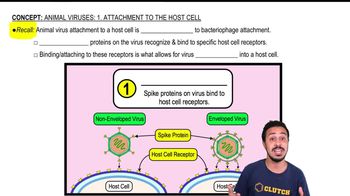
Pathogen Attachment to Host Receptors

Many pathogens initiate infection by binding to specific receptors on host cells, such as neurotransmitter or growth factor receptors. This attachment is crucial for entry or colonization and often mimics normal host ligand interactions, allowing the pathogen to exploit host cell functions.
추천 영상:
가이드 코스
03:12
Animal Viruses: 1. Attachment to the Host Cell

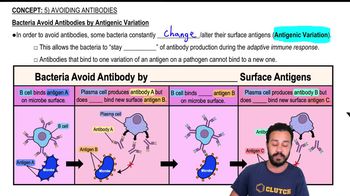
Antigenic Variation as an Immune Evasion Strategy

Some pathogens, like Neisseria gonorrhoeae, evade host immune defenses by frequently mutating their surface proteins. This antigenic variation prevents the immune system from recognizing and effectively targeting the pathogen, allowing persistent infection.
추천 영상:
가이드 코스
04:10
Bacteria Avoid Antibodies by Antigenic Variation

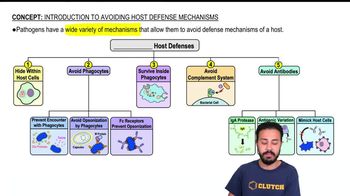
Mechanisms of Avoiding Host Immune Defenses

Pathogens use diverse strategies to avoid immune detection, including receptor mimicry, binding to immune regulators, or altering surface antigens. Understanding these mechanisms helps differentiate between direct receptor attachment for entry and active immune evasion tactics like antigenic variation.
추천 영상:
가이드 코스
01:59
Introduction to Avoiding Host Defense Mechanisms