 뒤로
뒤로Amines: Structure, Properties, Nomenclature, Synthesis, and Reactions
스터디 가이드 - 스마트 노트
 자료에 맞춘 맞춤형 노트, 핵심 정의, 예시, 맥락을 확장해 제공합니다.
Amines: Structure, Properties, Nomenclature, Synthesis, and Reactions
Introduction to Amines
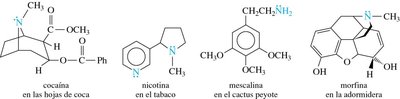
Amines are organic derivatives of ammonia (NH3) in which one or more hydrogen atoms are replaced by alkyl or aryl groups. They are widely found in nature, including in neurotransmitters, hormones, vitamins, and alkaloids. Many amines are biologically active and play crucial roles in living organisms.
Key Point: Amines are classified based on the number of organic substituents attached to the nitrogen atom.
Key Point: Amines are present in many natural products, such as alkaloids and pharmaceuticals.
Classification and Nomenclature of Amines
Classification of Amines
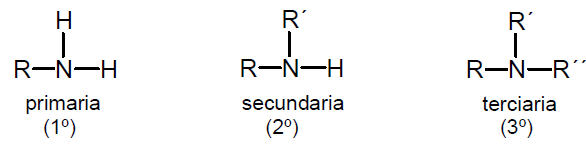
Amines are classified as primary (1°), secondary (2°), tertiary (3°), or quaternary ammonium salts based on the number of carbon-containing groups attached to the nitrogen atom.
Primary amine (1°): One alkyl or aryl group attached to nitrogen (RNH2).
Secondary amine (2°): Two alkyl or aryl groups attached to nitrogen (R2NH).
Tertiary amine (3°): Three alkyl or aryl groups attached to nitrogen (R3N).
Quaternary ammonium salt (4°): Four organic groups attached to nitrogen, which carries a positive charge (R4N+).
Nomenclature of Amines
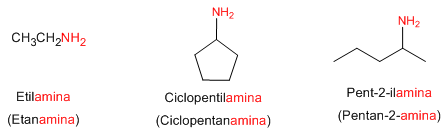
The IUPAC system names amines as derivatives of alkylamines or alkanoamines. The longest carbon chain attached to the nitrogen determines the parent name, and the suffix -amine is used. Substituents on nitrogen are indicated by the prefix 'N-'.
Rule 1: Name as alkylamine or alkanoamine based on the parent chain.
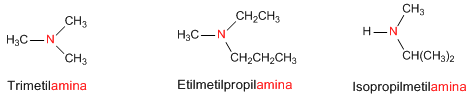
Rule 2: Use prefixes di-, tri-, etc., for identical substituents; list different substituents alphabetically.
Rule 3: Substituents directly attached to nitrogen are indicated with 'N-'.
Rule 4: If the amine is not the principal functional group, use the prefix 'amino-'.
Aromatic and Heterocyclic Amines
Aromatic amines have the amino group attached to a benzene ring and are named as derivatives of aniline. Heterocyclic amines contain nitrogen within a ring structure, with nitrogen assigned position 1.
Example: Aniline, N,N-diethylaniline, 4-methylaniline (p-toluidine).
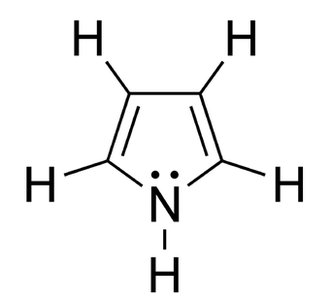
Heterocyclic examples: Pyrrole, pyrrolidine, pyridine, imidazole, etc.
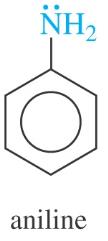
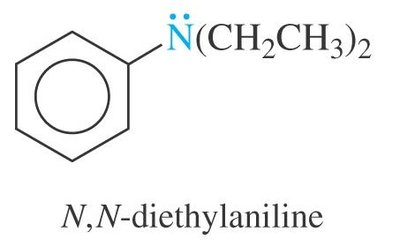
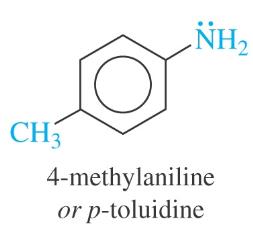
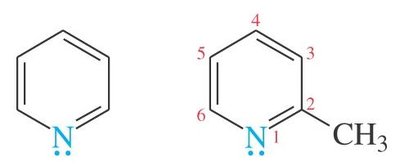
Structure and Physical Properties of Amines
Electronic Structure and Geometry
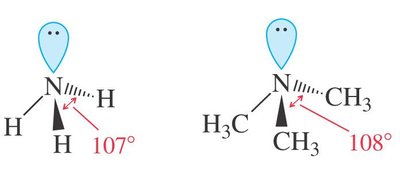
The nitrogen atom in amines is sp3 hybridized, with a lone pair of electrons. The bond angles are slightly less than the ideal tetrahedral angle due to the repulsion of the lone pair.
Ammonia (NH3): H-N-H bond angle is about 107°.
Trimethylamine: The bond angle increases slightly due to the presence of bulkier alkyl groups (about 108°).
Chirality in Amines
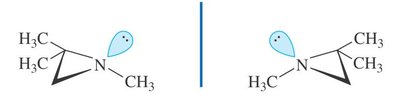
Amines can be chiral if nitrogen is attached to three different groups and has a lone pair. However, rapid inversion at nitrogen prevents isolation of enantiomers, except in rigid systems (e.g., aziridines).
Example: Chiral aziridines can have stable enantiomers due to restricted inversion.
Physical Properties: Boiling Point, Solubility, and Odor
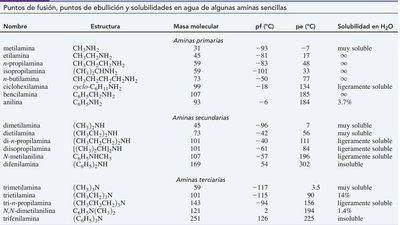
Amines are polar compounds due to the lone pair on nitrogen. Primary and secondary amines can form hydrogen bonds, leading to higher boiling points compared to similar alkanes and ethers. Tertiary amines cannot form hydrogen bonds as donors, only as acceptors.
Boiling Points: Primary & secondary amines > tertiary amines ≈ ethers ≈ alkanes (of similar mass).
Solubility: Small amines (<6 carbons) are soluble in water due to hydrogen bonding; solubility decreases with increasing chain length.
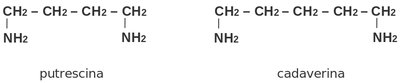
Odor: Many amines have a characteristic fishy smell (e.g., putrescine, cadaverine).
Basicity of Amines
Lewis and Brønsted-Lowry Basicity
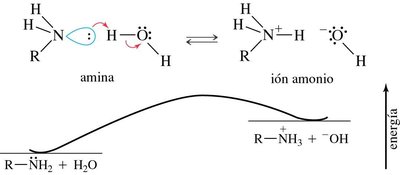
Amines act as Lewis bases (electron pair donors) and Brønsted-Lowry bases (proton acceptors) due to the lone pair on nitrogen. In aqueous solution, amines react with water to form ammonium ions and hydroxide ions, making the solution basic.
Equation:
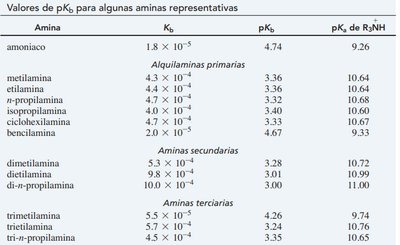
Base dissociation constant:
pKb:
Factors Affecting Basicity
Alkyl Substituents: Alkyl groups increase basicity by inductive electron donation, stabilizing the ammonium ion.
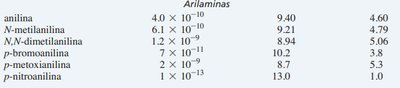
Resonance: Delocalization of the nitrogen lone pair (as in aniline) decreases basicity.
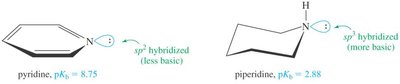
Hybridization: Nitrogen in sp2 or sp hybridized orbitals holds electrons more tightly, reducing basicity (e.g., pyridine vs. piperidine).
Salts of Amines (Ammonium Salts)
Formation and Properties
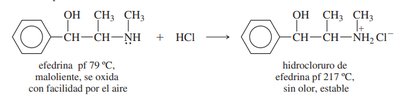
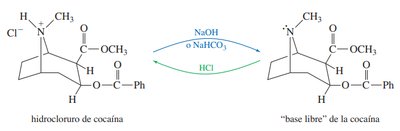
Protonation of an amine with an acid yields an ammonium salt, which is ionic, has a high melting point, is water-soluble, and is generally odorless. Many drugs are stored and administered as amine salts for stability and solubility.
Example: Ephedrine hydrochloride is more stable and less odorous than free ephedrine.
Example: Cocaine is often transported as its hydrochloride salt for similar reasons.

Importance and Applications of Amines
Amines are essential in biology and industry. Quaternary ammonium salts are used as phase-transfer catalysts, and many amines are active ingredients in pharmaceuticals and agrochemicals.
Example: Tetrabutylammonium chloride is a common phase-transfer catalyst.
Synthesis of Amines
Reductive Amination
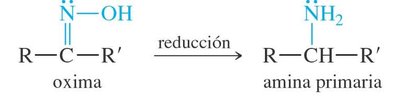
This is a general method for preparing amines. An aldehyde or ketone reacts with ammonia or an amine to form an imine or oxime, which is then reduced to an amine.
Primary amines: Aldehyde/ketone + hydroxylamine → oxime → reduction → primary amine.
Secondary amines: Aldehyde/ketone + primary amine → imine → reduction → secondary amine.
Tertiary amines: Aldehyde/ketone + secondary amine → iminium salt → reduction → tertiary amine.



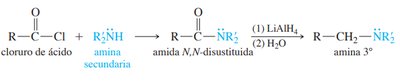
Acilation-Reduction (Amide Reduction)
An acyl chloride reacts with ammonia or an amine to form an amide, which is then reduced (commonly with LiAlH4) to an amine.
Ammonia yields primary amines.
Primary amines yield secondary amines.
Secondary amines yield tertiary amines.

Direct Alkylation of Ammonia
Alkyl halides react with ammonia to give a mixture of primary, secondary, and tertiary amines, and quaternary ammonium salts. Excess ammonia favors primary amine formation, but mixtures are common.
Mechanism: Nucleophilic substitution (SN2).

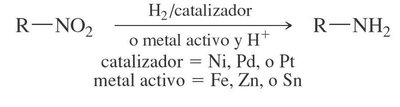
Reduction of Nitro Compounds
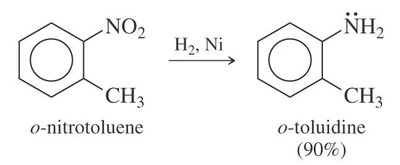
Nitro groups (-NO2) can be reduced to amines (-NH2) using catalytic hydrogenation or metals in acid. This is a common method for synthesizing aromatic amines (e.g., aniline).
Equation:
Reduction of Nitriles
Nitriles (R-C≡N) can be reduced to primary amines using hydrogenation or LiAlH4.
Equation:
Chemical Properties and Reactions of Amines
Reactions with Alkyl Halides (Alkylation)
Amines react with alkyl halides via nucleophilic substitution to form higher-order amines and quaternary ammonium salts.
Excess alkyl halide: Leads to exhaustive alkylation and formation of quaternary ammonium salts.
Reactions with Acyl Chlorides (Acilation)
Amines react with acyl chlorides to form amides. This reaction is important for reducing the reactivity of aromatic amines in further reactions.
Reactions with Sulfonyl Chlorides
Primary and secondary amines react with sulfonyl chlorides to form sulfonamides, which are important as antibacterial agents (sulfa drugs).
Reactions with Aldehydes and Ketones
Amines react with carbonyl compounds to form imines (Schiff bases), oximes, hydrazones, and related derivatives.
Hofmann Elimination
Quaternary ammonium salts undergo elimination upon heating with base to yield alkenes, typically the least substituted (Hofmann) product.
Oxidation of Amines
Amines can be oxidized by agents such as hydrogen peroxide. Primary and secondary amines yield hydroxylamines or nitroso compounds; tertiary amines yield amine oxides.
Cope Elimination
Tertiary amine oxides undergo syn elimination (Cope elimination) to yield alkenes under mild conditions.
Diazonium Salts and Reactions with Nitrous Acid
Formation of Diazonium Salts
Primary amines react with nitrous acid (generated in situ from NaNO2 and HCl) to form diazonium salts. Aliphatic diazonium salts are unstable, while aromatic diazonium salts are important intermediates in organic synthesis.
Secondary amines: Form N-nitrosoamines, which are carcinogenic.
Tertiary amines: Do not form stable diazonium salts.
Reactions of Aromatic Diazonium Salts
Aromatic diazonium salts can be used to synthesize phenols, aryl halides, nitriles, and azo compounds via Sandmeyer and related reactions.
Additional info: For further reading, see Wade Jr. L. G. (2012). Química Orgánica. Séptima Edición. Pearson Educación. Capítulo 19. Aminas pp. 872-928.
