뒤로
뒤로
문제 1a
Would you expect the following to produce an equal or unequal mixture of stereoisomers?
(a)
문제 1b
Would you expect the following to produce an equal or unequal mixture of stereoisomers?
(b)
문제 1c
Would you expect the following to produce an equal or unequal mixture of stereoisomers?
(c)
문제 2
Show a mechanism for the formation of one isomer in each of the reactions in Assessment 9.1.
(c)
문제 3c
Calculate the index of hydrogen deficiency for the following molecules.
(c)
문제 4b
Determine the oxidation number of each carbon indicated by an arrow.
(b)
문제 4c
Determine the oxidation number of each carbon indicated by an arrow.
(c)
문제 4e
Determine the oxidation number of each carbon indicated by an arrow.
(e)
문제 4f
Determine the oxidation number of each carbon indicated by an arrow.
(f)
문제 4g
Determine the oxidation number of each carbon indicated by an arrow.
(g)
문제 4h
Determine the oxidation number of each carbon indicated by an arrow.
(h)
문제 5b
Use oxidation numbers to determine which of the following are redox reactions.
(b)
문제 5c
Use oxidation numbers to determine which of the following are redox reactions.
(c)
문제 5d
Use oxidation numbers to determine which of the following are redox reactions.
(d)
문제 5e
Use oxidation numbers to determine which of the following are redox reactions.
(e)
문제 6b
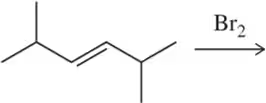
Predict the product(s) of each of the following reactions, making sure to indicate the relative stereochemical outcome. Indicate any racemic mixtures by drawing both enantiomers.
(b)
문제 6c
Predict the product(s) of each of the following reactions, making sure to indicate the relative stereochemical outcome. Indicate any racemic mixtures by drawing both enantiomers.
(c)
문제 6f
Predict the product(s) of each of the following reactions, making sure to indicate the relative stereochemical outcome. Indicate any racemic mixtures by drawing both enantiomers.
(f)
- Calculate the atom economy for the reactions shown. In each, what happens to the percentage of material that is not incorporated into the major product?
문제 7
문제 7a
Provide an arrow-pushing mechanism that rationalizes the stereospecific formation of each dihalide in Assessment 9.6.
문제 8
In which of the two steps in the alkene halogenation mechanism does a redox reaction occur?
- (••) Predict the product(s) that would result when the alkenes are allowed to react under the following conditions: (iii) Br₂, H₂O (h)
문제 9
문제 9a
In contrast to the addition of Br₂ the addition of HBr [Section 8.3] is not stereospecific. Why?
문제 10a
Predict the product(s) of each of the following reactions, making sure to indicate the relative stereochemical outcome. Indicate any racemic mixtures by drawing both enantiomers.
(a)
문제 11
Provide arrow-pushing mechanisms for Assessments 9.10(b) and 9.10(c) that rationalize the regioselective and stereospecific formation of each halohydrin.
(b)
(c)
문제 12
Explain why water attacks the carbon of the bromonium ion as opposed to the bromonium ion itself in the second step of halohydrin formation.
문제 13a
Suggest an alkene that could be used to make each of the following halohydrins.
(a)
문제 13c
Suggest an alkene that could be used to make each of the following halohydrins.
(c)
문제 14
How does the carbonyl in mCPBA weaken the O―O σ bond (i.e., make a better leaving group)?
문제 15
Calculate the atom economy of the reaction in Figure 9.24. [Catalysts are not included in the atom economy calculation.]