Ch. 9 - Alkenes 2: Oxidation and Reduction
Mullins - Organic Chemistry: A Learner Centered Approach 1st Edition
Mullins1st EditionOrganic Chemistry: A Learner Centered ApproachISBN: 9780137566471당신이 사용하는 게 아니라요?교과서 변경
8장, 문제 4c

Determine the oxidation number of each carbon indicated by an arrow.
(c)

검증된 단계별 안내
1
Identify the structure: The image shows a benzene ring, which is a six-membered carbon ring with alternating double bonds.
Determine the general rule for oxidation numbers: In organic chemistry, the oxidation number of carbon is determined by the number of electrons it 'owns' compared to its neutral state.
Assign electrons: In a C-C bond, each carbon gets one electron. In a C-H bond, carbon gets both electrons. In a C=C bond, each carbon gets one electron from the double bond.
Calculate the oxidation number: For the carbon indicated by the arrow, count the electrons it 'owns' and compare it to the number of valence electrons in a neutral carbon atom (which is 4).
Apply the formula: The oxidation number is calculated as the difference between the number of valence electrons in the neutral atom and the number of electrons 'owned' by the atom in the molecule.

비슷한 문제에 대한 검증된 영상 답변:

이 영상 해법은 위 문제에 도움이 된다고 튜터들이 추천한 것입니다.

주요 개념

질문에 올바르게 답하기 위해 반드시 이해해야 하는 핵심 개념들은 다음과 같습니다.

Oxidation Number

The oxidation number, or oxidation state, is a theoretical charge assigned to an atom in a molecule, reflecting its degree of oxidation. It helps in understanding electron transfer in redox reactions. For carbon, common oxidation states range from -4 in methane (CH4) to +4 in carbon dioxide (CO2), depending on the number of bonds it forms with more electronegative elements.
추천 영상:
03:40
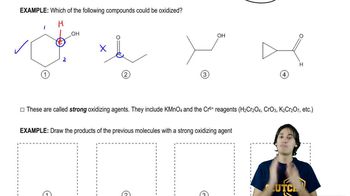
Strong oxidizing agents

Electronegativity

Electronegativity is the tendency of an atom to attract electrons in a chemical bond. In determining oxidation numbers, the relative electronegativities of the atoms involved are crucial. For example, when carbon is bonded to more electronegative atoms like oxygen or chlorine, it typically has a higher oxidation state due to the electron pull from these atoms.
추천 영상:
1:47
Electronegativity

Rules for Assigning Oxidation Numbers

There are specific rules for assigning oxidation numbers, which include: the oxidation number of an atom in its elemental form is zero, the oxidation number of a monoatomic ion is equal to its charge, and in compounds, the sum of oxidation numbers must equal the overall charge of the molecule. These rules guide the determination of oxidation states for each carbon in a given structure.
추천 영상:
03:54
The 18 and 16 Electron Rule