뒤로
뒤로
문제 1a
Draw three-dimensional representations of the following amino acids.
(a) L-phenylalanine
문제 1b
Draw three-dimensional representations of the following amino acids.
(b) L-histidine
문제 1c
Draw three-dimensional representations of the following amino acids.
(c) D-serine
문제 1d
Draw three-dimensional representations of the following amino acids.
(d) L-tryptophan
문제 2a
Most naturally occurring amino acids have chiral centers (the asymmetric α carbon atoms) that are named (S) by the Cahn–Ingold–Prelog convention (Section 5-3). The common naturally occurring form of cysteine has a chiral center that is named (R), however.
(a) What is the relationship between (R)-cysteine and (S)-alanine? Do they have the opposite three-dimensional configuration (as the names might suggest) or the same configuration?
문제 2b
Most naturally occurring amino acids have chiral centers (the asymmetric α carbon atoms) that are named (S) by the Cahn–Ingold–Prelog convention (Section 5-3). The common naturally occurring form of cysteine has a chiral center that is named (R), however.
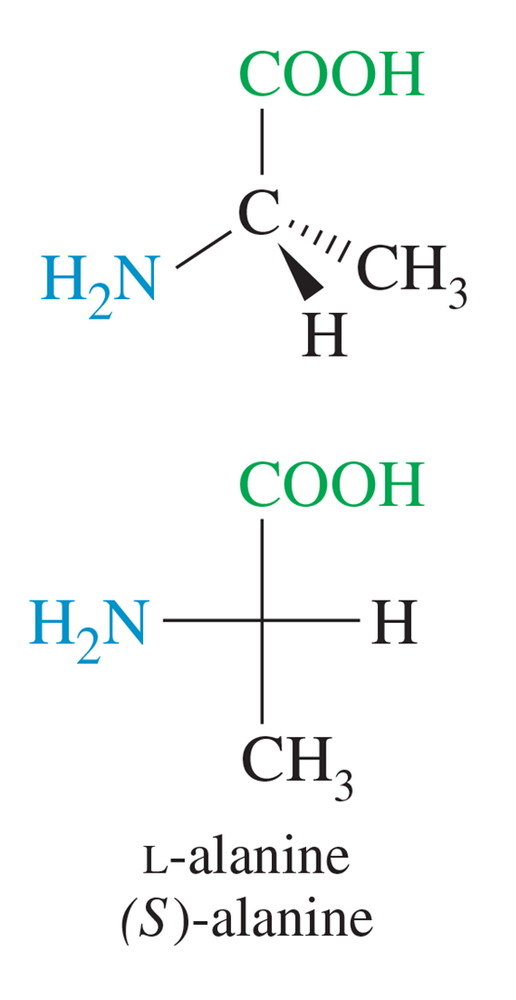
(b) (S)-Alanine is an L-amino acid (Figure 24-2). Is (R)-cysteine a d-amino acid or an L-amino acid?
문제 3
The herbicide glyphosate (Roundup®) kills plants by inhibiting an enzyme needed for synthesis of phenylalanine. Deprived of phenylalanine, the plant cannot make the proteins it needs, and it gradually weakens and dies. Although a small amount of glyphosate is deadly to a plant, its human toxicity is quite low. Suggest why this powerful herbicide has little effect on humans.
문제 4a
Draw the structure of the predominant form of
(a) isoleucine at pH 11.
문제 4b
Draw the structure of the predominant form of
(b) proline at pH 2.
문제 4d
Draw the structure of the predominant form of
(d) glutamic acid at pH 7.
문제 4e(iii)
Draw the structure of the predominant form of
(e) a mixture of alanine, lysine, and aspartic acid at (iii) pH 2.
문제 4e(i)
Draw the structure of the predominant form of
(e) a mixture of alanine, lysine, and aspartic acid at (i) pH 6;
문제 6
Although tryptophan contains a heterocyclic amine, it is considered a neutral amino acid. Explain why the indole nitrogen of tryptophan is more weakly basic than one of the imidazole nitrogens of histidine.
문제 7
Draw the electrophoretic separation of Ala, Lys, and Asp at pH 9.7.
문제 8
Draw the electrophoretic separation of Trp, Cys, and His at pH 6.0.
문제 9a
Show how the following amino acids might be formed in the laboratory by reductive amination of the appropriate α-ketoacid.
(a) alanine
문제 10b
Show how you would use bromination followed by amination to synthesize the following amino acids.
(b) leucine
문제 11a
Show how you would use a Strecker synthesis to make phenylalanine.
문제 11b(1)
Propose a mechanism for each step in the synthesis in part (a).
문제 11b(2)
Propose a mechanism for each step in the synthesis in part (a).
문제 12b
Show how you would use a Strecker synthesis to make
(b) valine.
문제 12c
Show how you would use a Strecker synthesis to make
(c) aspartic acid.
문제 13
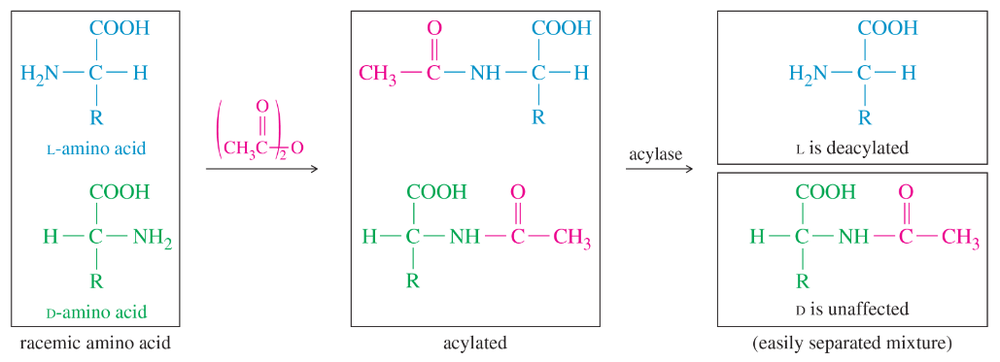
Suggest how you would separate the free L-amino acid from its acylated D enantiomer in Figure 24-5.
문제 15
Give equations for the formation and hydrogenolysis of glutamine benzyl ester.
문제 16
Give equations for the formation and hydrogenolysis of N-benzyloxycarbonyl methionine.
문제 17
Use resonance forms to show delocalization of the negative charge in the Ruhemann's purple anion.
문제 19a
Draw the structure of the phenylthiohydantoin derivatives of
(a) alanine.
문제 19c
Draw the structure of the phenylthiohydantoin derivatives of
(c) lysine.
문제 24a
Propose a mechanism for the coupling of acetic acid and aniline using DCC as a coupling agent.
문제 27a
(a) The isoelectric point (pI) of phenylalanine is pH 5.5. Draw the structure of the major form of phenylalanine at pH values of 1, 5.5, and 11.