Although tryptophan contains a heterocyclic amine, it is considered a neutral amino acid. Explain why the indole nitrogen of tryptophan is more weakly basic than one of the imidazole nitrogens of histidine.
Ch. 24 - Amino Acids, Peptides, and Proteins
24장, 문제 4d
Draw the structure of the predominant form of
(d) glutamic acid at pH 7.
검증된 단계별 안내1
Identify the functional groups in glutamic acid: Glutamic acid contains an amino group (-NH₂), a carboxylic acid group (-COOH) attached to the alpha carbon, and a second carboxylic acid group (-COOH) in the side chain.
Determine the pKa values of the functional groups: The pKa values for glutamic acid are approximately 2.1 for the alpha carboxylic acid, 4.1 for the side chain carboxylic acid, and 9.7 for the amino group.
Compare the pH (7) to the pKa values to determine the protonation state of each group: At pH 7, the alpha carboxylic acid (pKa = 2.1) and the side chain carboxylic acid (pKa = 4.1) will both be deprotonated (-COO⁻), while the amino group (pKa = 9.7) will remain protonated (-NH₃⁺).
Draw the zwitterionic structure of glutamic acid: Represent the molecule with the alpha carbon bonded to the deprotonated alpha carboxylate group (-COO⁻), the protonated amino group (-NH₃⁺), the hydrogen atom, and the side chain containing the deprotonated carboxylate group (-COO⁻).
Verify the overall charge of the molecule: At pH 7, the molecule should have a net charge of -1, as there are two negatively charged carboxylate groups (-COO⁻) and one positively charged amino group (-NH₃⁺).

비슷한 문제에 대한 검증된 영상 답변:
이 영상 해법은 위 문제에 도움이 된다고 튜터들이 추천한 것입니다.
영상 길이:
1m주요 개념
질문에 올바르게 답하기 위해 반드시 이해해야 하는 핵심 개념들은 다음과 같습니다.
Amino Acids
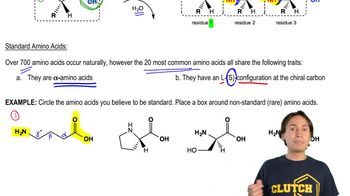
Amino acids are organic compounds that serve as the building blocks of proteins. Each amino acid contains a central carbon atom, an amino group (-NH2), a carboxyl group (-COOH), a hydrogen atom, and a variable side chain (R group). The properties of the side chain determine the characteristics of the amino acid, including its polarity and charge, which are crucial for understanding its behavior in different pH environments.
추천 영상:
Standard Amino Acids
pH and Ionization
pH is a measure of the acidity or basicity of a solution, influencing the ionization state of molecules. At pH 7, which is neutral, amino acids can exist in a zwitterionic form, where the amino group is protonated (-NH3+) and the carboxyl group is deprotonated (-COO-). This ionization affects the overall charge and solubility of the amino acid, which is essential for drawing its predominant structure at this pH.
추천 영상:
Ionization Potentials
Glutamic Acid Structure
Glutamic acid is a polar, negatively charged amino acid at physiological pH due to its side chain containing a carboxyl group. Its structure includes a central carbon atom bonded to an amino group, a carboxyl group, a hydrogen atom, and a side chain that is another carboxyl group. Understanding its structure is vital for predicting its behavior in biological systems and its role in protein synthesis and metabolism.
추천 영상:
가이드 코스
Citric Acid Cycle Structures Concept 1
관련 실천
교과서 질문
907
views
교과서 질문
Draw the structure of the predominant form of
(e) a mixture of alanine, lysine, and aspartic acid at (iii) pH 2.
800
views
교과서 질문
The herbicide glyphosate (Roundup®) kills plants by inhibiting an enzyme needed for synthesis of phenylalanine. Deprived of phenylalanine, the plant cannot make the proteins it needs, and it gradually weakens and dies. Although a small amount of glyphosate is deadly to a plant, its human toxicity is quite low. Suggest why this powerful herbicide has little effect on humans.
1969
views
교과서 질문
Draw the structure of the predominant form of
(b) proline at pH 2.
1719
views
교과서 질문
Draw the structure of the predominant form of
(e) a mixture of alanine, lysine, and aspartic acid at (i) pH 6;
1565
views
교과서 질문
Draw the structure of the predominant form of
(a) isoleucine at pH 11.
2043
views
2
rank