
Ch. 03 - Kinematics in Two or Three Dimensions; Vectors
Giancoli Douglas - Physics for Scientists and Engineers 5th edition
Giancoli Douglas5th editionPhysics for Scientists and EngineersISBN: 9780137488179당신이 사용하는 게 아니라요?교과서 변경
3장, 문제 23a

A skier is accelerating down a 30.0° hill at 1.80 m/s² (Fig. 3–42). What is the vertical component of her acceleration?
<IMAGE>

검증된 단계별 안내
1
Identify the given values: The acceleration of the skier down the hill is 1.80 m/s², and the angle of the hill with respect to the horizontal is 30.0°.
Understand the problem: The vertical component of the acceleration is the portion of the skier's acceleration that acts in the vertical direction (perpendicular to the horizontal). This can be determined using trigonometry.
Use the sine function to find the vertical component of the acceleration. The relationship is given by: avertical = atotal ⋅ sin(θ), where atotal is the total acceleration (1.80 m/s²) and θ is the angle of the hill (30.0°).
Substitute the known values into the equation: avertical = 1.80 ⋅ sin(30.0°). Note that the sine of 30.0° is a known trigonometric value.
Simplify the expression to find the vertical component of the acceleration. Ensure the units remain consistent (m/s²).

비슷한 문제에 대한 검증된 영상 답변:

이 영상 해법은 위 문제에 도움이 된다고 튜터들이 추천한 것입니다.
도움이 되었나요?

주요 개념

질문에 올바르게 답하기 위해 반드시 이해해야 하는 핵심 개념들은 다음과 같습니다.

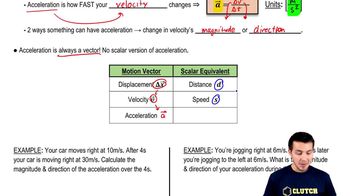
Acceleration

Acceleration is the rate of change of velocity of an object with respect to time. In this context, it refers to the skier's change in speed as she moves down the hill. The acceleration can be influenced by various factors, including gravity, friction, and the incline of the hill.
추천 영상:
가이드 코스
05:47
Intro to Acceleration

Components of Acceleration

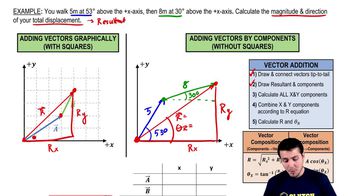
When dealing with inclined planes, acceleration can be broken down into components: vertical and horizontal. The vertical component is influenced by gravity and the angle of the incline, while the horizontal component relates to the skier's movement along the slope. Understanding these components is essential for analyzing motion on an incline.
추천 영상:
가이드 코스
07:30
Vector Addition By Components

Trigonometric Functions

Trigonometric functions, such as sine and cosine, are used to relate the angles of a triangle to the ratios of its sides. In this scenario, the vertical component of the skier's acceleration can be calculated using the sine function, which helps determine how much of the total acceleration acts in the vertical direction based on the angle of the hill.
추천 영상:
가이드 코스
08:30
Intro to Wave Functions