Ch. 03 - Kinematics in Two or Three Dimensions; Vectors
Giancoli Douglas - Physics for Scientists and Engineers 5th edition
Giancoli Douglas5th editionPhysics for Scientists and EngineersISBN: 9780137488179당신이 사용하는 게 아니라요?교과서 변경
3장, 문제 21

A car is moving with speed 16.0 m/s due south at one moment and 25.7 m/s due east 8.00 s later. Over this time interval, determine the magnitude and direction of (a) its average velocity, (b) its average acceleration. (c) What is its average speed? [Hint: Can you determine all these from the information given?]

검증된 단계별 안내
1
Step 1: Understand the problem. The car's motion involves a change in velocity over a time interval of 8.00 s. The initial velocity is 16.0 m/s due south, and the final velocity is 25.7 m/s due east. We need to calculate (a) the average velocity, (b) the average acceleration, and (c) the average speed. Note that velocity is a vector quantity, while speed is scalar.
Step 2: Calculate the average velocity. The average velocity is defined as the displacement vector divided by the time interval. To find the displacement, treat the initial and final velocities as vectors and use the Pythagorean theorem to determine the resultant displacement vector. Then divide this displacement by the time interval (8.00 s). Use the formula: vavg = ΔrΔt, where Δr is the displacement vector.
Step 3: Calculate the average acceleration. Average acceleration is defined as the change in velocity divided by the time interval. Since velocity is a vector, calculate the change in velocity by subtracting the initial velocity vector from the final velocity vector. Use vector subtraction and then divide by the time interval (8.00 s). The formula is: aavg = ΔvΔt, where Δv is the change in velocity vector.
Step 4: Determine the direction of the average velocity and average acceleration. For both, use trigonometry to find the angle of the resultant vector relative to a reference direction (e.g., east or south). Use the tangent function: θ = tan-1yx, where y and x are the components of the vector.
Step 5: Calculate the average speed. Average speed is the total distance traveled divided by the time interval. Since the car's motion involves two perpendicular components (south and east), calculate the total distance traveled by summing the magnitudes of the two velocity components multiplied by the time interval. Use the formula: vavg = dΔt, where d is the total distance traveled.

비슷한 문제에 대한 검증된 영상 답변:

이 영상 해법은 위 문제에 도움이 된다고 튜터들이 추천한 것입니다.
도움이 되었나요?

주요 개념

질문에 올바르게 답하기 위해 반드시 이해해야 하는 핵심 개념들은 다음과 같습니다.

Average Velocity

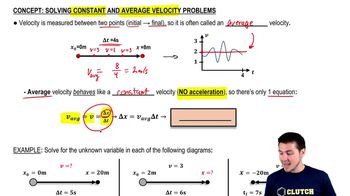
Average velocity is defined as the total displacement divided by the total time taken. It is a vector quantity, meaning it has both magnitude and direction. In this scenario, the displacement can be calculated using the initial and final positions of the car, while the time interval is given as 8 seconds. The direction of average velocity will be determined by the vector sum of the initial and final velocities.
추천 영상:
가이드 코스
05:44
Solving Constant and Average Velocity Problems

Average Acceleration

Average acceleration is the change in velocity divided by the time over which that change occurs. It is also a vector quantity, indicating both how much the velocity changes and in which direction. To find the average acceleration in this case, one must calculate the difference between the final and initial velocities and then divide by the time interval of 8 seconds.
추천 영상:
가이드 코스
05:44
Solving Constant and Average Velocity Problems

Average Speed

Average speed is defined as the total distance traveled divided by the total time taken, and it is a scalar quantity, meaning it only has magnitude and no direction. In this problem, average speed can be calculated by determining the total distance the car traveled during the 8 seconds, which can be derived from the speeds at the two points and the time interval.
추천 영상:
가이드 코스
05:44
Solving Constant and Average Velocity Problems