Ch. 03 - Kinematics in Two or Three Dimensions; Vectors
Giancoli Douglas - Physics for Scientists and Engineers 5th edition
Giancoli Douglas5th editionPhysics for Scientists and EngineersISBN: 9780137488179당신이 사용하는 게 아니라요?교과서 변경
3장, 문제 17b

Two vectors, V⃗1\(\vec{V}\)_1 and V⃗2\(\vec{V}\)_2, add to a resultant V⃗R=V⃗1+V⃗2\(\vec{V}\)_R = \(\vec{V}\)_1 + \(\vec{V}\)_2. Describe V⃗1\(\vec{V}\)_1 and V⃗2\(\vec{V}\)_2 if VR2=V12+V22V_R^2 = V_1^2 + V_2^2.

검증된 단계별 안내
1
Step 1: Recognize that the equation Vᵣ² = V₁² + V₂² resembles the Pythagorean theorem, which applies to right triangles. This suggests that the vectors V₁ and V₂ are perpendicular to each other.
Step 2: Understand that when two vectors are perpendicular, their resultant vector forms the hypotenuse of a right triangle, with the two vectors as the legs of the triangle.
Step 3: To confirm this, recall that the magnitude of the resultant vector Vᵣ is given by |Vᵣ| = √(V₁² + V₂²) when the vectors are perpendicular. Squaring both sides gives Vᵣ² = V₁² + V₂², which matches the given condition.
Step 4: Conclude that V₁ and V₂ must be at a 90° angle to each other for the given relationship Vᵣ² = V₁² + V₂² to hold true.
Step 5: If needed, represent the vectors graphically or mathematically to verify their perpendicularity, ensuring that the angle between them is indeed 90°.

비슷한 문제에 대한 검증된 영상 답변:

이 영상 해법은 위 문제에 도움이 된다고 튜터들이 추천한 것입니다.
영상 길이:
2m

주요 개념

질문에 올바르게 답하기 위해 반드시 이해해야 하는 핵심 개념들은 다음과 같습니다.

Vector Addition

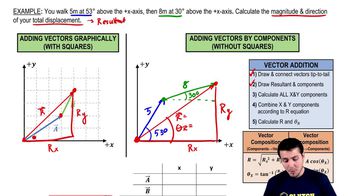
Vector addition is the process of combining two or more vectors to produce a resultant vector. This involves adding the corresponding components of the vectors, which can be visualized graphically using the head-to-tail method. The resultant vector represents the cumulative effect of the individual vectors in both magnitude and direction.
추천 영상:
가이드 코스
07:30
Vector Addition By Components

Pythagorean Theorem in Vector Context

The Pythagorean theorem states that in a right triangle, the square of the length of the hypotenuse is equal to the sum of the squares of the lengths of the other two sides. In the context of vectors, if two vectors are perpendicular, the magnitude of the resultant vector can be calculated using this theorem, leading to the equation Vᵣ² = V₁² + V₂².
추천 영상:
가이드 코스
13:46
Parallel Axis Theorem

Magnitude of a Vector

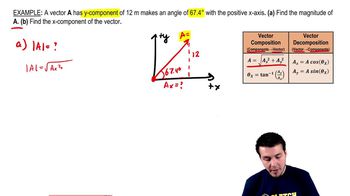
The magnitude of a vector is a measure of its length or size, regardless of its direction. It is calculated using the square root of the sum of the squares of its components. Understanding the magnitude is crucial for vector addition, especially when applying the Pythagorean theorem to find the resultant vector's length when vectors are orthogonal.
추천 영상:
가이드 코스
03:59
Calculating Magnitude & Components of a Vector