
Ch. 13 - Fluids
Giancoli Douglas - Physics for Scientists and Engineers 5th edition
Giancoli Douglas5th editionPhysics for Scientists and EngineersISBN: 9780137488179당신이 사용하는 게 아니라요?교과서 변경
13장, 문제 99

Estimate the total mass of the Earth’s atmosphere, using the known value of atmospheric pressure at sea level.

검증된 단계별 안내
1
Start by recalling that atmospheric pressure at sea level is approximately 101,325 Pa (Pascals). This pressure is caused by the weight of the column of air above a unit area of the Earth's surface.
Use the relationship between pressure, force, and area: \( P = \frac{F}{A} \), where \( P \) is pressure, \( F \) is force, and \( A \) is area. Rearrange this to find the total force exerted by the atmosphere: \( F = P \cdot A \).
The force \( F \) is equal to the weight of the atmosphere, which can be expressed as \( F = m \cdot g \), where \( m \) is the mass of the atmosphere and \( g \) is the acceleration due to gravity (approximately 9.8 m/s²). Combine this with the previous equation to get \( m = \frac{P \cdot A}{g} \).
To calculate the total mass, substitute the total surface area of the Earth into the equation. The surface area of a sphere is given by \( A = 4 \pi R^2 \), where \( R \) is the radius of the Earth (approximately 6.371 \(\times\) 10^6 \) meters).
Substitute the known values for \( P \), \( g \), and \( A \) into the equation \( m = \frac{P \cdot A}{g} \) to estimate the total mass of the Earth's atmosphere. Simplify the expression to find the result.

비슷한 문제에 대한 검증된 영상 답변:

이 영상 해법은 위 문제에 도움이 된다고 튜터들이 추천한 것입니다.
영상 길이:
3m
도움이 되었나요?

주요 개념

질문에 올바르게 답하기 위해 반드시 이해해야 하는 핵심 개념들은 다음과 같습니다.

Atmospheric Pressure

Atmospheric pressure is the force exerted by the weight of air above a given point, typically measured at sea level. At sea level, this pressure is approximately 101,325 pascals (Pa). Understanding atmospheric pressure is crucial for estimating the mass of the atmosphere, as it relates directly to the weight of the air column above a specific area.
추천 영상:
가이드 코스
17:04
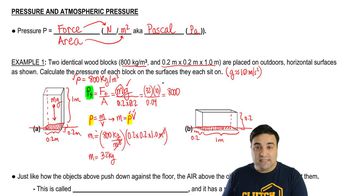
Pressure and Atmospheric Pressure

Area and Force Relationship

The relationship between force, area, and pressure is defined by the equation P = F/A, where P is pressure, F is force, and A is area. To estimate the total mass of the atmosphere, one can rearrange this equation to find the force (weight) exerted by the atmosphere over a specific area, which can then be used to calculate the total mass by dividing the force by the acceleration due to gravity.
추천 영상:
가이드 코스
03:43
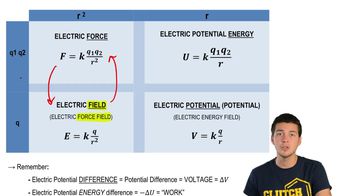
Relationships Between Force, Field, Energy, Potential

Mass Calculation from Pressure

To estimate the total mass of the atmosphere, one can multiply the atmospheric pressure at sea level by the surface area of the Earth. The total mass can be derived from the weight of the atmosphere, which is the product of pressure and area, divided by the acceleration due to gravity. This approach provides a practical method to quantify the mass of the atmosphere using readily available data.
추천 영상:
가이드 코스
13:11
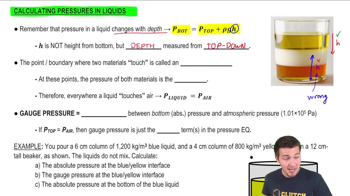
Calculating Pressure in Liquids