
Ch. 13 - Fluids
Giancoli Douglas - Physics for Scientists and Engineers 5th edition
Giancoli Douglas5th editionPhysics for Scientists and EngineersISBN: 9780137488179당신이 사용하는 게 아니라요?교과서 변경
13장, 문제 93

You are watering your lawn with a hose when you put your finger over the hose opening to increase the distance the water reaches. If you are holding the hose horizontally, and the distance the water reaches increases by a factor of 4, what fraction of the hose opening did you block?

검증된 단계별 안내
1
Understand the relationship between the range of the water stream and the velocity of the water exiting the hose. The horizontal range of a projectile (in this case, the water) is proportional to the square of its initial velocity: \( R \propto v^2 \). Since the range increases by a factor of 4, the velocity must increase by a factor of \( \sqrt{4} = 2 \).
Recognize that the velocity of the water exiting the hose is related to the pressure and the cross-sectional area of the hose opening. According to the principle of conservation of mass (continuity equation), the flow rate \( Q \) is constant: \( Q = A v \), where \( A \) is the cross-sectional area of the opening and \( v \) is the velocity of the water.
Since the velocity increases by a factor of 2, the cross-sectional area of the opening must decrease to maintain the same flow rate. Specifically, \( A_{new} = \frac{A_{original}}{2} \), because \( v_{new} = 2v_{original} \).
The fraction of the hose opening that was blocked can be determined by comparing the new area to the original area. The blocked fraction is given by \( 1 - \frac{A_{new}}{A_{original}} \). Substituting \( A_{new} = \frac{A_{original}}{2} \), the blocked fraction becomes \( 1 - \frac{1}{2} = \frac{1}{2} \).
Conclude that you blocked half of the hose opening to achieve the increased range of the water stream.

비슷한 문제에 대한 검증된 영상 답변:

이 영상 해법은 위 문제에 도움이 된다고 튜터들이 추천한 것입니다.
영상 길이:
6m

주요 개념

질문에 올바르게 답하기 위해 반드시 이해해야 하는 핵심 개념들은 다음과 같습니다.

Bernoulli's Principle

Bernoulli's Principle states that in a flowing fluid, an increase in the fluid's speed occurs simultaneously with a decrease in pressure or potential energy. This principle helps explain how blocking part of the hose opening increases the velocity of the water exiting the hose, allowing it to reach a greater distance.
추천 영상:
가이드 코스
14:47
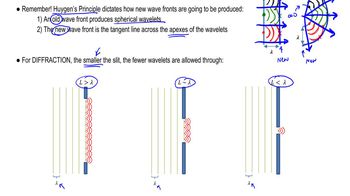
Diffraction with Huygen's Principle

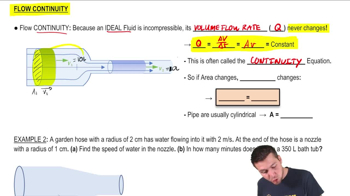
Continuity Equation

The Continuity Equation in fluid dynamics asserts that the mass flow rate must remain constant from one cross-section of a pipe to another. This means that if the cross-sectional area of the hose is reduced by blocking it, the speed of the water must increase to maintain the same flow rate, which is crucial for understanding how the water's reach changes.
추천 영상:
가이드 코스
11:08
Flow Continuity

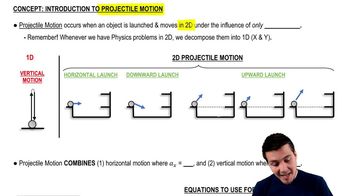
Projectile Motion

Projectile Motion refers to the motion of an object that is thrown or projected into the air, influenced only by gravity and its initial velocity. In this scenario, the water behaves like a projectile after leaving the hose, and its horizontal distance is affected by the initial speed, which is increased by blocking the hose opening.
추천 영상:
가이드 코스
04:44
Introduction to Projectile Motion
관련 실천
교과서 질문

A drinking fountain shoots water about 12 cm up in the air from a nozzle of diameter 0.60 cm (Fig. 13–67). The pump at the base of the unit (1.1 m below the nozzle) pushes water into a 1.2-cm-diameter supply pipe that goes up to the nozzle. What gauge pressure does the pump have to provide? Ignore the viscosity; your answer will therefore be an underestimate.

<IMAGE>

1434
views
교과서 질문

Estimate the total mass of the Earth’s atmosphere, using the known value of atmospheric pressure at sea level.

1666
views
교과서 질문

When you ascend or descend a great deal when driving in a car, your ears “pop,” which means that the pressure behind the eardrum is being equalized to that outside. If this did not happen, what would be the approximate force on an eardrum of area 0.20cm² if a change in altitude of 1120 m takes place?

1574
views
교과서 질문

A ship, carrying fresh water to a desert island in the Caribbean, has a horizontal cross-sectional area of 2240 m² at the waterline. When unloaded, the ship rises 8.55 m higher in the sea. How much water (m³) was delivered?

1335
views
교과서 질문

When a person drives or hikes to a higher altitude, and even more during descent, volume changes of trapped air in the middle ear can cause ear discomfort until the middle-ear pressure and exterior pressure are equalized. If a rapid descent at a rate of 7.0 m/s or faster commonly causes ear discomfort, what is the maximum rate of increase in atmospheric pressure (that is, dP/dt) tolerable to most people?

1461
views