
Ch. 13 - Fluids
Giancoli Douglas - Physics for Scientists and Engineers 5th edition
Giancoli Douglas5th editionPhysics for Scientists and EngineersISBN: 9780137488179당신이 사용하는 게 아니라요?교과서 변경
13장, 문제 89a

When a person drives or hikes to a higher altitude, and even more during descent, volume changes of trapped air in the middle ear can cause ear discomfort until the middle-ear pressure and exterior pressure are equalized. If a rapid descent at a rate of 7.0 m/s or faster commonly causes ear discomfort, what is the maximum rate of increase in atmospheric pressure (that is, dP/dt) tolerable to most people?

검증된 단계별 안내
1
Understand the relationship between pressure and altitude: Atmospheric pressure decreases with increasing altitude and increases with decreasing altitude. The rate of change of pressure with respect to time (dP/dt) depends on the rate of descent and the pressure gradient with altitude.
Use the barometric formula to express the relationship between pressure and altitude: \( P = P_0 e^{-h/H} \), where \( P_0 \) is the pressure at sea level, \( h \) is the altitude, and \( H \) is the scale height of the atmosphere (approximately 8,400 m).
Differentiate the barometric formula with respect to time to find \( \frac{dP}{dt} \): \( \frac{dP}{dt} = \frac{dP}{dh} \cdot \frac{dh}{dt} \). Here, \( \frac{dh}{dt} \) is the rate of descent (given as 7.0 m/s), and \( \frac{dP}{dh} \) can be derived from the barometric formula.
Calculate \( \frac{dP}{dh} \) using the derivative of the barometric formula: \( \frac{dP}{dh} = -\frac{P}{H} \). Substitute this into the expression for \( \frac{dP}{dt} \): \( \frac{dP}{dt} = -\frac{P}{H} \cdot \frac{dh}{dt} \).
Substitute the known values: \( H = 8400 \ \text{m} \), \( \frac{dh}{dt} = -7.0 \ \text{m/s} \) (negative because it is a descent), and \( P \) is the atmospheric pressure at the current altitude. Simplify the expression to find the maximum tolerable \( \frac{dP}{dt} \).

비슷한 문제에 대한 검증된 영상 답변:

이 영상 해법은 위 문제에 도움이 된다고 튜터들이 추천한 것입니다.
영상 길이:
3m
도움이 되었나요?

주요 개념

질문에 올바르게 답하기 위해 반드시 이해해야 하는 핵심 개념들은 다음과 같습니다.

Atmospheric Pressure

Atmospheric pressure is the force exerted by the weight of air above a given point, typically measured in pascals (Pa) or millibars (mb). As altitude decreases, atmospheric pressure increases due to the greater density of air at lower elevations. Understanding how pressure changes with altitude is crucial for comprehending the discomfort experienced during rapid descents.
추천 영상:
17:04
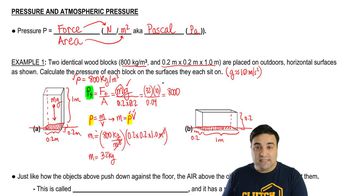
Pressure and Atmospheric Pressure

Pressure Equalization

Pressure equalization refers to the process by which the pressure in the middle ear is balanced with the external atmospheric pressure. This is typically achieved through the Eustachian tube, which connects the middle ear to the throat. When there is a rapid change in altitude, the inability to equalize pressure quickly can lead to discomfort or pain in the ears.
추천 영상:
17:04
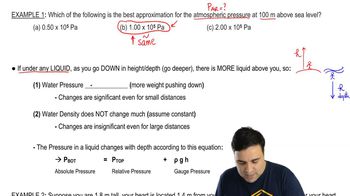
Pressure and Atmospheric Pressure

Rate of Change of Pressure (dP/dt)

The rate of change of pressure, denoted as dP/dt, quantifies how quickly the atmospheric pressure changes over time. In the context of rapid descents, a high dP/dt can lead to discomfort as the body struggles to equalize the pressure in the middle ear. Understanding this rate helps in determining safe descent speeds to minimize ear discomfort.
추천 영상:
15:27
Pressure In Air and In Liquids
관련 실천
교과서 질문

You are watering your lawn with a hose when you put your finger over the hose opening to increase the distance the water reaches. If you are holding the hose horizontally, and the distance the water reaches increases by a factor of 4, what fraction of the hose opening did you block?

1177
views
교과서 질문

Estimate the total mass of the Earth’s atmosphere, using the known value of atmospheric pressure at sea level.

1666
views
교과서 질문

A hydraulic lift is used to jack a 960-kg car 52 cm off the floor. The diameter of the output piston is 18 cm, and the input force is 380 N. What is the area of the input piston?

1134
views
교과서 질문

When you ascend or descend a great deal when driving in a car, your ears “pop,” which means that the pressure behind the eardrum is being equalized to that outside. If this did not happen, what would be the approximate force on an eardrum of area 0.20cm² if a change in altitude of 1120 m takes place?

1574
views
교과서 질문

A ship, carrying fresh water to a desert island in the Caribbean, has a horizontal cross-sectional area of 2240 m² at the waterline. When unloaded, the ship rises 8.55 m higher in the sea. How much water (m³) was delivered?

1335
views
교과서 질문

A pump supplies water to a 1.59-cm inner diameter hose that tapers down to a 0.953-cm-diameter nozzle. The nozzle is aimed so water comes out at a 45° angle and lands 3.0 m away. The nozzle is 0.60 m above ground level, and the pump output is essentially at ground level. What pressure is supplied by the pump?

1049
views