Ch. 14 - Oscillations
Giancoli Douglas - Physics for Scientists and Engineers 5th edition
Giancoli Douglas5th editionPhysics for Scientists and EngineersISBN: 9780137488179당신이 사용하는 게 아니라요?교과서 변경
14장, 문제 16a

Determine the phase constant ϕ in Eq. 14–4 if, at t = 0, the oscillating mass is at 𝓍 = ― A.

검증된 단계별 안내
1
Start by recalling the equation for simple harmonic motion: 𝓍(t) = A cos(ωt + ϕ), where 𝓍(t) is the displacement, A is the amplitude, ω is the angular frequency, t is time, and ϕ is the phase constant.
At t = 0, substitute t = 0 into the equation: 𝓍(0) = A cos(ϕ). This simplifies to 𝓍(0) = A cos(ϕ).
The problem states that at t = 0, the displacement 𝓍 = -A. Substitute 𝓍(0) = -A into the equation: -A = A cos(ϕ).
Divide both sides of the equation by A (assuming A ≠ 0): -1 = cos(ϕ).
To solve for ϕ, use the inverse cosine function: ϕ = cos⁻¹(-1). The value of ϕ that satisfies this equation is π radians (or 180°).

비슷한 문제에 대한 검증된 영상 답변:

이 영상 해법은 위 문제에 도움이 된다고 튜터들이 추천한 것입니다.
영상 길이:
2m
도움이 되었나요?

주요 개념

질문에 올바르게 답하기 위해 반드시 이해해야 하는 핵심 개념들은 다음과 같습니다.

Simple Harmonic Motion (SHM)

Simple Harmonic Motion is a type of periodic motion where an object oscillates around an equilibrium position. The motion can be described by a sine or cosine function, characterized by parameters such as amplitude, angular frequency, and phase constant. Understanding SHM is crucial for analyzing oscillatory systems, as it provides the foundational equations that govern the behavior of the mass-spring system.
추천 영상:
07:52
Simple Harmonic Motion of Pendulums

Phase Constant (ϕ)

The phase constant, denoted as ϕ, determines the initial position of an oscillating object at time t = 0. It shifts the sine or cosine function along the time axis, allowing for the description of various starting conditions in oscillatory motion. In the context of the given problem, finding ϕ is essential to accurately represent the state of the mass when it is at its maximum negative displacement.
추천 영상:
08:59
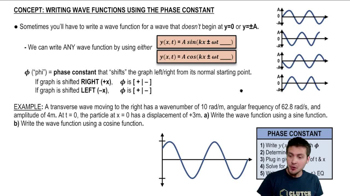
Phase Constant of a Wave Function

Amplitude (A)

Amplitude is the maximum displacement of an oscillating object from its equilibrium position. In the context of SHM, it represents the peak value of the oscillation, indicating how far the object moves from the center. Knowing the amplitude is vital for determining the phase constant, as it sets the scale for the oscillation and helps in visualizing the motion of the mass.
추천 영상:
04:24
Amplitude Decay in an LRC Circuit