


A mass resting on a horizontal, frictionless surface is attached to one end of a spring; the other end of the spring is fixed to a wall. It takes 3.2 J of work to compress the spring by 0.13 m. The mass is then released from rest and experiences a maximum acceleration of 12m/s². Find the value of the spring constant.
Ch. 14 - Oscillations
Giancoli Douglas5th editionPhysics for Scientists and EngineersISBN: 9780137488179당신이 사용하는 게 아니라요?교과서 변경
14장, 문제 16c
Determine the phase constant ϕ in Eq. 14–4 if, at t = 0, the oscillating mass is at 𝓍 = A .
검증된 단계별 안내1
Understand the context of the problem: The equation for simple harmonic motion is given as 𝓍(t) = A cos(ωt + ϕ), where 𝓍(t) is the displacement at time t, A is the amplitude, ω is the angular frequency, and ϕ is the phase constant. We are tasked with finding the phase constant ϕ when the displacement 𝓍 = A at t = 0.
Substitute the given conditions into the equation: At t = 0, the displacement 𝓍 = A. Substituting these values into the equation 𝓍(t) = A cos(ωt + ϕ), we get A = A cos(ϕ).
Simplify the equation: Divide both sides of the equation by A (assuming A ≠ 0), which gives 1 = cos(ϕ).
Interpret the result: The cosine of the phase constant ϕ is equal to 1. From trigonometry, we know that cos(ϕ) = 1 when ϕ = 0 radians (or 0 degrees).
Conclude the solution: Therefore, the phase constant ϕ is 0 radians in this case, as it satisfies the condition that 𝓍 = A at t = 0.

비슷한 문제에 대한 검증된 영상 답변:
이 영상 해법은 위 문제에 도움이 된다고 튜터들이 추천한 것입니다.
영상 길이:
3m도움이 되었나요?
주요 개념
질문에 올바르게 답하기 위해 반드시 이해해야 하는 핵심 개념들은 다음과 같습니다.
Simple Harmonic Motion (SHM)
Simple Harmonic Motion is a type of periodic motion where an object oscillates around an equilibrium position. The motion is characterized by a restoring force proportional to the displacement from the equilibrium, leading to sinusoidal motion. In SHM, parameters such as amplitude, frequency, and phase constant are crucial for describing the motion's characteristics.
추천 영상:
가이드 코스
Simple Harmonic Motion of Pendulums
Amplitude (A)
Amplitude is the maximum displacement of an oscillating object from its equilibrium position. In the context of SHM, it represents the peak value of the oscillation, indicating how far the object moves from the center point during its motion. The amplitude is a key factor in determining the energy of the oscillating system, as greater amplitudes correspond to higher energy levels.
추천 영상:
가이드 코스
Amplitude Decay in an LRC Circuit
Phase Constant (ϕ)
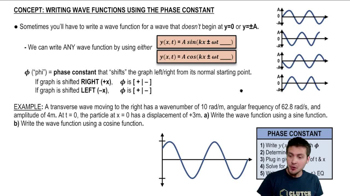
The phase constant, denoted as ϕ, is a parameter in the equation of motion for SHM that determines the initial position of the oscillating object at time t = 0. It effectively shifts the sine or cosine function used to describe the motion, allowing for the accurate representation of the system's state at the start of the observation. The value of ϕ is crucial for solving problems related to the timing and position of oscillations.
추천 영상:
가이드 코스
Phase Constant of a Wave Function
관련 실천
교과서 질문
1774
views
교과서 질문
Determine the phase constant ϕ in Eq. 14–4 if, at t = 0, the oscillating mass is at 𝓍 = ― A.
820
views
교과서 질문
Determine the phase constant ϕ in Eq. 14–4 if, at t = 0, the oscillating mass is at 𝓍 = ― 1/2 A.
661
views
교과서 질문
A 0.25-kg mass at the end of a spring oscillates 3.2 times per second with an amplitude of 0.15 m. Determine the equation describing the motion of the mass, assuming that at t = 0, 𝓍 was a maximum.
704
views
교과서 질문
An object with mass 2.7 kg is executing simple harmonic motion, attached to a spring with spring constant k = 310 N/m. When the object is 0.020 m from its equilibrium position, it is moving with a speed of 0.60 m/s. Calculate the maximum speed attained by the object.
1681
views
