Ch. 23 - Electric Potential
Giancoli Douglas - Physics for Scientists and Engineers 5th edition
Giancoli Douglas5th editionPhysics for Scientists and EngineersISBN: 9780137488179당신이 사용하는 게 아니라요?교과서 변경
22장, 문제 19

Suppose the end of your finger is charged.
(a) Estimate the breakdown voltage in air for your finger.
(b) About what surface charge density would have to be on your finger at this voltage?

검증된 단계별 안내
1
Estimate the breakdown voltage in air for your finger by using the approximate electric field strength required for air to break down, which is about 3 × 10^6 V/m. Assume the distance between your finger and the object is small, say 1 mm (0.001 m). Use the formula for electric field: E = V/d, where E is the electric field, V is the voltage, and d is the distance.
Rearrange the formula to solve for the breakdown voltage V = E × d. Substitute the values for E (3 × 10^6 V/m) and d (0.001 m) to estimate the breakdown voltage.
To calculate the surface charge density, use the relationship between the electric field and surface charge density: E = σ/ε0, where σ is the surface charge density and ε0 is the permittivity of free space (8.85 × 10^-12 C^2/N·m^2).
Rearrange the formula to solve for the surface charge density: σ = E × ε0. Substitute the value of E (3 × 10^6 V/m) and ε0 (8.85 × 10^-12 C^2/N·m^2) to find the surface charge density.
Combine the results from parts (a) and (b) to understand the relationship between the breakdown voltage and the surface charge density on your finger. This will give you a complete picture of the physical situation.

비슷한 문제에 대한 검증된 영상 답변:

이 영상 해법은 위 문제에 도움이 된다고 튜터들이 추천한 것입니다.
영상 길이:
6m
도움이 되었나요?

주요 개념

질문에 올바르게 답하기 위해 반드시 이해해야 하는 핵심 개념들은 다음과 같습니다.

Breakdown Voltage

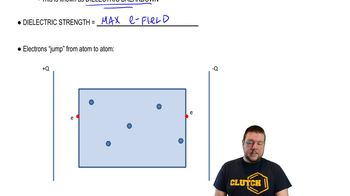
Breakdown voltage is the minimum voltage that causes a portion of an insulator to become electrically conductive. In air, this occurs when the electric field strength exceeds approximately 3 million volts per meter (3 MV/m). This phenomenon is crucial for understanding how and when air can conduct electricity, such as during lightning strikes or electrical discharges.
추천 영상:
가이드 코스
04:32
Dielectric Breakdown

Surface Charge Density

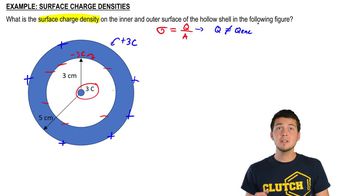
Surface charge density refers to the amount of electric charge per unit area on a surface. It is typically measured in coulombs per square meter (C/m²). To estimate the surface charge density on a charged object, one can use the relationship between the electric field and the charge distribution, which is essential for determining how much charge is needed to reach the breakdown voltage in air.
추천 영상:
가이드 코스
04:03
Surface Charge Density

Electric Field

An electric field is a region around a charged object where other charged objects experience a force. The strength of the electric field (E) is defined as the force (F) per unit charge (q) and is measured in volts per meter (V/m). Understanding electric fields is vital for analyzing how charges interact and for calculating the breakdown voltage and surface charge density in the context of the question.
추천 영상:
가이드 코스
03:16
Intro to Electric Fields