Ch. 23 - Electric Potential
Giancoli Douglas - Physics for Scientists and Engineers 5th edition
Giancoli Douglas5th editionPhysics for Scientists and EngineersISBN: 9780137488179당신이 사용하는 게 아니라요?교과서 변경
22장, 문제 23

A very long conducting cylinder (length ℓ) of radius R₀ (R₀ ≪ ℓ) carries a uniform surface charge density σ (C/m²). The cylinder is at an electric potential V₀. Determine the potential, at points far from the end, at a distance R from the center of the cylinder for
(a) R > R₀
(b) R < R₀.
(c) Is V = 0 at R = ∞ (assume ℓ = ∞ )? Explain. [Hint: Recall Gauss’s law.]

검증된 단계별 안내
1
Step 1: Recognize that the problem involves a long conducting cylinder with a uniform surface charge density σ and an electric potential V₀. To solve this, we will use Gauss's law to determine the electric field and then integrate to find the potential V at different regions (R > R₀ and R < R₀).
Step 2: For the region R > R₀ (outside the cylinder), use Gauss's law. Consider a cylindrical Gaussian surface of radius R and length ℓ (where R > R₀). The electric flux through the surface is given by Φ = E(2πRℓ), where E is the electric field. The enclosed charge is Q_enc = σ(2πR₀ℓ). Using Gauss's law, Φ = Q_enc/ε₀, we get E = (σR₀)/(ε₀R).
Step 3: For the region R < R₀ (inside the cylinder), note that the cylinder is a conductor. In a conductor, the electric field inside is zero (E = 0) because charges redistribute themselves to cancel any internal field. Therefore, the potential inside the cylinder is constant and equal to the potential at the surface, V₀.
Step 4: To find the potential V at a distance R > R₀, integrate the electric field E from R to infinity. The potential difference is given by V(R) - V(∞) = -∫(E dR). Substituting E = (σR₀)/(ε₀R), the integral becomes V(R) - V(∞) = -∫((σR₀)/(ε₀R) dR). Solve this integral to find V(R). Assume V(∞) = 0 for simplicity.
Step 5: For part (c), consider whether V = 0 at R = ∞. Since the cylinder is infinitely long (ℓ = ∞), the potential at infinity can be set to zero as a reference point. This is a common assumption in problems involving infinite charge distributions, as the potential difference is what matters physically.

비슷한 문제에 대한 검증된 영상 답변:

이 영상 해법은 위 문제에 도움이 된다고 튜터들이 추천한 것입니다.
영상 길이:
9m
도움이 되었나요?

주요 개념

질문에 올바르게 답하기 위해 반드시 이해해야 하는 핵심 개념들은 다음과 같습니다.

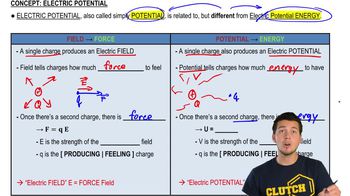
Electric Potential

Electric potential is the amount of electric potential energy per unit charge at a point in an electric field. It is measured in volts (V) and indicates the work done to move a charge from a reference point to a specific point in the field. Understanding electric potential is crucial for analyzing how charges interact with electric fields, especially in configurations like charged cylinders.
추천 영상:
가이드 코스
07:33
Electric Potential

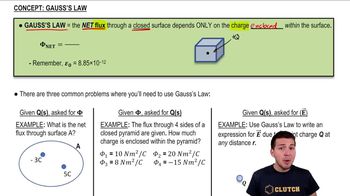
Gauss's Law

Gauss's Law relates the electric flux through a closed surface to the charge enclosed by that surface. Mathematically, it states that the total electric flux is proportional to the enclosed charge. This law is particularly useful for calculating electric fields and potentials in symmetric charge distributions, such as long cylinders, where direct integration would be complex.
추천 영상:

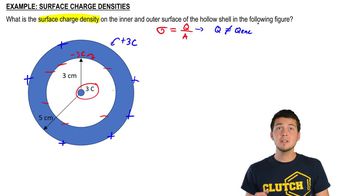
Surface Charge Density

Surface charge density (σ) is defined as the amount of charge per unit area on a surface, expressed in coulombs per square meter (C/m²). It is a critical parameter when dealing with charged objects, as it influences the electric field and potential around the object. In the context of the conducting cylinder, σ determines how the charge is distributed along its surface and affects the resulting electric potential at various distances.
추천 영상:
가이드 코스
04:03
Surface Charge Density