Ch. 24 - Capacitance, Dielectrics, Electric Energy, Storage
Giancoli Douglas - Physics for Scientists and Engineers 5th edition
Giancoli Douglas5th editionPhysics for Scientists and EngineersISBN: 9780137488179당신이 사용하는 게 아니라요?교과서 변경
23장, 문제 84

A parallel-plate capacitor has square plates 12 cm on a side separated by 0.10 mm of plastic with a dielectric constant of K = 3.8. The plates are connected to a battery, causing them to become oppositely charged. Since the oppositely charged plates attract each other, they exert a pressure on the dielectric. If this pressure is 40.0 Pa, what is the battery voltage?

검증된 단계별 안내
1
Convert all given quantities to SI units. The side length of the square plates is 12 cm, which is 0.12 m. The separation between the plates is 0.10 mm, which is 0.0001 m. The dielectric constant is K = 3.8, and the pressure is 40.0 Pa.
Recall the relationship between the pressure exerted on the dielectric and the electric field in the capacitor: \( P = \frac{1}{2} \varepsilon_0 K E^2 \), where \( P \) is the pressure, \( \varepsilon_0 \) is the permittivity of free space (\( 8.85 \times 10^{-12} \ \text{F/m} \)), \( K \) is the dielectric constant, and \( E \) is the electric field.
Rearrange the formula to solve for the electric field \( E \): \( E = \sqrt{\frac{2P}{\varepsilon_0 K}} \). Substitute the known values for \( P \), \( \varepsilon_0 \), and \( K \) into this equation to calculate \( E \).
The relationship between the electric field \( E \) and the voltage \( V \) across the plates is given by \( E = \frac{V}{d} \), where \( d \) is the separation between the plates. Rearrange this formula to solve for \( V \): \( V = E \cdot d \). Substitute the value of \( E \) from the previous step and the given value of \( d \) to calculate \( V \).
Combine all the steps to express the battery voltage \( V \) in terms of the given quantities: \( V = d \cdot \sqrt{\frac{2P}{\varepsilon_0 K}} \). This formula can now be used to compute the battery voltage if needed.

비슷한 문제에 대한 검증된 영상 답변:

이 영상 해법은 위 문제에 도움이 된다고 튜터들이 추천한 것입니다.
영상 길이:
4m
도움이 되었나요?

주요 개념

질문에 올바르게 답하기 위해 반드시 이해해야 하는 핵심 개념들은 다음과 같습니다.

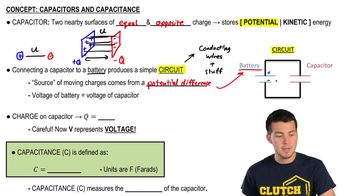
Capacitance

Capacitance is the ability of a capacitor to store charge per unit voltage. It is defined by the formula C = εA/d, where C is capacitance, ε is the permittivity of the dielectric material, A is the area of the plates, and d is the separation between them. The presence of a dielectric material increases the capacitance by a factor equal to the dielectric constant (K).
추천 영상:
가이드 코스
08:02
Capacitors & Capacitance (Intro)

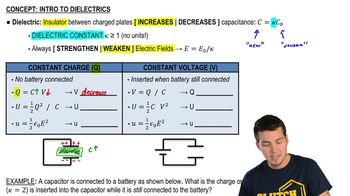
Dielectric Constant

The dielectric constant (K) is a measure of a material's ability to store electrical energy in an electric field. It is a dimensionless number that indicates how much the electric field is reduced within the material compared to a vacuum. A higher dielectric constant means the material can store more charge, which affects the overall capacitance of the capacitor.
추천 영상:
가이드 코스
06:25
Intro To Dielectrics

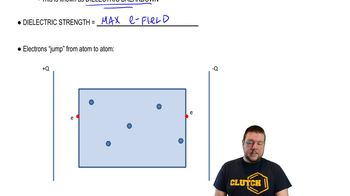
Pressure in Dielectrics

When a capacitor is charged, the electric field between the plates exerts forces on the dielectric material, leading to a pressure. This pressure can be calculated using the formula P = εE^2/2, where P is the pressure, ε is the permittivity of the dielectric, and E is the electric field strength. Understanding this relationship is crucial for determining the voltage across the capacitor when the pressure is known.
추천 영상:
가이드 코스
04:32
Dielectric Breakdown
관련 실천
교과서 질문

What is the capacitance of a pair of circular plates with a radius of 5.0 cm separated by 2.3 mm of mica?

1695
views

교과서 질문

A parallel-plate capacitor with plate area 2.0 cm² and air-gap separation 0.50 mm is connected to a 12-V battery, and fully charged. The battery is then disconnected. What is the charge on the capacitor?

1391
views
교과서 질문

Capacitors can be used as “electric charge counters.” Consider an initially uncharged capacitor of capacitance C with its bottom plate grounded and its top plate connected to a source of electrons. If N electrons flow onto the capacitor’s top plate, show that the resulting potential difference V across the capacitor is directly proportional to N.

1391
views
교과서 질문

The capacitor shown in Fig. 24–34 is connected to an 80.0-V battery. Calculate (and sketch) the electric field everywhere between the capacitor plates. Find both the free charge on each capacitor plate and the induced charge on the faces of the glass dielectric plate.

57
views
교과서 질문

A 3500-pF air-gap capacitor is connected to an 18-V battery. If a piece of mica fills the space between the plates, how much charge will flow from the battery?

1287
views
교과서 질문

A parallel-plate capacitor with plate area 2.0 cm² and air-gap separation 0.50 mm is connected to a 12-V battery, and fully charged. The battery is then disconnected. The plates are now pulled to a separation of 0.85 mm. What is the charge on the capacitor now?

1284
views