
교과서 질문
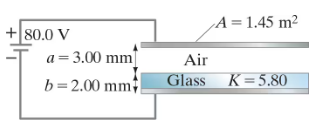
What is the capacitance of a pair of circular plates with a radius of 5.0 cm separated by 2.3 mm of mica?
1695
views

 검증된 단계별 안내
 06:13
06:13
 08:02
08:02 06:25
06:25What is the capacitance of a pair of circular plates with a radius of 5.0 cm separated by 2.3 mm of mica?
A parallel-plate capacitor with plate area 2.0 cm² and air-gap separation 0.50 mm is connected to a 12-V battery, and fully charged. The battery is then disconnected. What is the charge on the capacitor?
A cylindrical capacitor (Example 24–2) has Rₐ = 3.5 mm and R₆.= 0.50 mm. The two conductors have a potential difference of 625 V, with the inner conductor at the higher potential. Calculate the energy stored in a 1.0-m length of the capacitor.
A 3500-pF air-gap capacitor is connected to an 18-V battery. If a piece of mica fills the space between the plates, how much charge will flow from the battery?
A parallel-plate capacitor has square plates 12 cm on a side separated by 0.10 mm of plastic with a dielectric constant of K = 3.8. The plates are connected to a battery, causing them to become oppositely charged. Since the oppositely charged plates attract each other, they exert a pressure on the dielectric. If this pressure is 40.0 Pa, what is the battery voltage?
A parallel-plate capacitor with plate area 2.0 cm² and air-gap separation 0.50 mm is connected to a 12-V battery, and fully charged. The battery is then disconnected. The plates are now pulled to a separation of 0.85 mm. What is the charge on the capacitor now?