Ch. 24 - Capacitance, Dielectrics, Electric Energy, Storage
Giancoli Douglas - Physics for Scientists and Engineers 5th edition
Giancoli Douglas5th editionPhysics for Scientists and EngineersISBN: 9780137488179당신이 사용하는 게 아니라요?교과서 변경
23장, 문제 53

What is the capacitance of a pair of circular plates with a radius of 5.0 cm separated by 2.3 mm of mica?

검증된 단계별 안내
1
Start by recalling the formula for the capacitance of a parallel plate capacitor: C=εd⋅A, where ε is the permittivity of the material between the plates, d is the separation between the plates, and A is the area of one plate.
Determine the permittivity of mica. The permittivity ε is given by ε=ε0⋅κ, where ε0 is the permittivity of free space (8.85×10⁻¹² F/m) and κ is the dielectric constant of mica (approximately 7).
Calculate the area of one circular plate using the formula for the area of a circle: A=π⋅r2, where r is the radius of the plate. Convert the radius from centimeters to meters before substituting into the formula.
Convert the separation between the plates from millimeters to meters. This is necessary to ensure all units are consistent in the SI system.
Substitute the values for ε, A, and d into the capacitance formula to calculate the capacitance. Ensure that all calculations are performed with consistent units.

비슷한 문제에 대한 검증된 영상 답변:

이 영상 해법은 위 문제에 도움이 된다고 튜터들이 추천한 것입니다.
영상 길이:
3m

주요 개념

질문에 올바르게 답하기 위해 반드시 이해해야 하는 핵심 개념들은 다음과 같습니다.

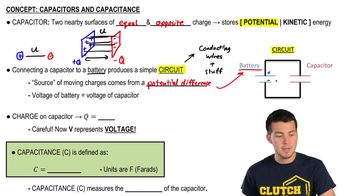
Capacitance

Capacitance is the ability of a system to store electric charge per unit voltage. It is defined as the ratio of the electric charge (Q) stored on the plates to the potential difference (V) between them, expressed as C = Q/V. The unit of capacitance is the farad (F), and it is influenced by the physical characteristics of the capacitor, including the area of the plates and the distance between them.
추천 영상:
가이드 코스
08:02
Capacitors & Capacitance (Intro)

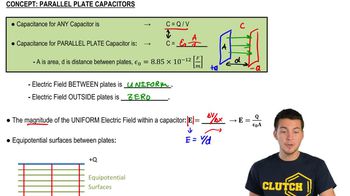
Parallel Plate Capacitor

A parallel plate capacitor consists of two conductive plates separated by an insulating material, known as a dielectric. The capacitance of such a capacitor can be calculated using the formula C = (ε₀ * ε_r * A) / d, where ε₀ is the permittivity of free space, ε_r is the relative permittivity of the dielectric, A is the area of one plate, and d is the separation between the plates. This configuration allows for efficient charge storage.
추천 영상:
가이드 코스
08:53
Parallel Plate Capacitors

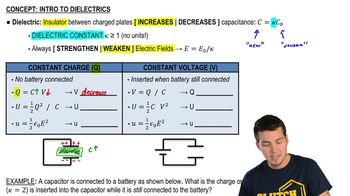
Dielectric Material

A dielectric material is an insulating substance that can be polarized by an electric field, which enhances the capacitance of a capacitor. Mica, in this case, is a type of dielectric with a high relative permittivity (ε_r), which increases the capacitor's ability to store charge compared to a vacuum. The presence of a dielectric reduces the electric field strength between the plates, allowing for greater charge accumulation.
추천 영상:
가이드 코스
06:25
Intro To Dielectrics
관련 실천
교과서 질문

Suppose in Fig. 24–27 that C₁ = C₃ = 8.0μF, C₂ = C₄ = 16μF, and Q₃ = 21μC. Determine the voltage Vba across the combination.

1438
views

교과서 질문

Two capacitors connected in parallel produce an equivalent capacitance of 32.9-μF, but when connected in series the equivalent capacitance is only 5.5 μF. What is the individual capacitance of each capacitor?

1499
views
교과서 질문

The capacitor shown in Fig. 24–34 is connected to an 80.0-V battery. Calculate (and sketch) the electric field everywhere between the capacitor plates. Find both the free charge on each capacitor plate and the induced charge on the faces of the glass dielectric plate.

57
views
교과서 질문

A cylindrical capacitor (Example 24–2) has Rₐ = 3.5 mm and R₆.= 0.50 mm. The two conductors have a potential difference of 625 V, with the inner conductor at the higher potential. Calculate the energy stored in a 1.0-m length of the capacitor.

1262
views
교과서 질문

A 3500-pF air-gap capacitor is connected to an 18-V battery. If a piece of mica fills the space between the plates, how much charge will flow from the battery?

1287
views
교과서 질문

A parallel-plate capacitor has square plates 12 cm on a side separated by 0.10 mm of plastic with a dielectric constant of K = 3.8. The plates are connected to a battery, causing them to become oppositely charged. Since the oppositely charged plates attract each other, they exert a pressure on the dielectric. If this pressure is 40.0 Pa, what is the battery voltage?

1340
views