

Ch. 34 - The Wave Nature of Light: Interference and Polarization
Giancoli Douglas - Physics for Scientists and Engineers 5th edition
Giancoli Douglas5th editionPhysics for Scientists and EngineersISBN: 9780137488179당신이 사용하는 게 아니라요?교과서 변경
33장, 문제 49

What is Brewster’s angle for an air-glass (n = 1.56) surface? Specify two answers.

검증된 단계별 안내
1
Understand the concept: Brewster's angle is the angle of incidence at which light with a particular polarization is perfectly transmitted through a surface, with no reflection. It is given by the formula: θB = arctan(n2/n1), where n1 is the refractive index of the first medium (air, in this case, with n1 = 1) and n2 is the refractive index of the second medium (glass, with n2 = 1.56).
Substitute the given values into the formula: θB = arctan(1.56/1). This simplifies to θB = arctan(1.56).
Calculate the arctangent of 1.56 to find the Brewster's angle in degrees. Use a scientific calculator or software to perform this step.
Recognize that Brewster's angle is typically measured relative to the normal of the surface. The second answer refers to the complementary angle, which is 90° - θB.
Summarize: The two answers are the Brewster's angle itself and its complementary angle. Ensure both are expressed in degrees for clarity.

비슷한 문제에 대한 검증된 영상 답변:

이 영상 해법은 위 문제에 도움이 된다고 튜터들이 추천한 것입니다.
영상 길이:
3m
도움이 되었나요?

주요 개념

질문에 올바르게 답하기 위해 반드시 이해해야 하는 핵심 개념들은 다음과 같습니다.

Brewster's Angle

Brewster's angle is the angle of incidence at which light with a particular polarization is perfectly transmitted through a transparent dielectric surface, with no reflection. It is given by the formula θ_B = arctan(n), where n is the refractive index of the second medium relative to the first. This angle is significant in optics, particularly in applications involving polarized light.
추천 영상:

Refractive Index

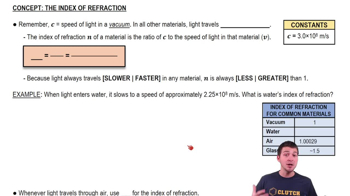
The refractive index (n) is a dimensionless number that describes how light propagates through a medium. It is defined as the ratio of the speed of light in a vacuum to the speed of light in the medium. For example, in the case of air-glass interface, the refractive index of glass is typically greater than that of air, affecting how light bends when entering or exiting the material.
추천 영상:
가이드 코스
03:46
Index of Refraction

Polarization of Light

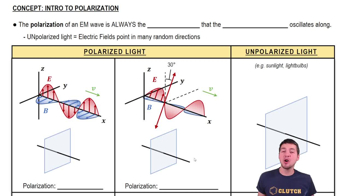
Polarization refers to the orientation of the oscillations of light waves in a particular direction. Light can be polarized in various ways, such as through reflection, refraction, or by passing through polarizing filters. Understanding polarization is crucial for applications involving Brewster's angle, as it determines the conditions under which light is transmitted or reflected at the interface.
추천 영상:
가이드 코스
05:32
Introduction to Polarization
관련 실천
교과서 질문

Light of wavelength 5.0 x 10⁻⁷ passes through two parallel slits and falls on a screen 5.0 m away. Adjacent bright bands of the interference pattern are 2.0 cm apart.

(a) Find the distance between the slits.

(b) The same two slits are next illuminated by light of a different wavelength, and the fifth minimum for this light occurs at the same point on the screen as the fourth minimum for the previous light. What is the wavelength of the second source of light?

60
views
교과서 질문

A single optical coating reduces reflection to zero for λ = 550 nm. By what factor is the intensity reduced by the coating for λ = 430 nm and λ = 670 nm as compared to no coating? Assume normal incidence.

132
views
교과서 질문

Show that the radius r of the mᵗʰ dark Newton’s ring, as viewed from directly above (Fig. 34–18), is given by r = √mλR where R is the radius of curvature of the curved glass surface and λ is the wavelength of light used. Assume that the thickness of the air gap is much less than R at all points and that r ≪ R . [Hint: Use the binomial expansion.]

125
views
교과서 질문

What would Brewster’s angle be for reflections off the surface of water for light coming from beneath the surface? Compare to the angle for total internal reflection, and to Brewster’s angle from above the surface.

1338
views
교과서 질문

Light of wavelength 690 nm passes through two narrow slits 0.66 mm apart. The screen is 1.75 m away. A second source of unknown wavelength produces its second-order fringe 1.23 mm closer to the central maximum than the 690-nm light. What is the wavelength of the unknown light?

59
views
교과서 질문

(II) When a Newton’s ring apparatus (Fig. 34–18) is immersed in a liquid, the diameter of the tenth dark ring decreases from 2.92 cm to 2.54 cm. What is the refractive index of the liquid? [Hint: See Problem 37.]

62
views