
Ch. 34 - The Wave Nature of Light: Interference and Polarization
Giancoli Douglas - Physics for Scientists and Engineers 5th edition
Giancoli Douglas5th editionPhysics for Scientists and EngineersISBN: 9780137488179당신이 사용하는 게 아니라요?교과서 변경
33장, 문제 42

A single optical coating reduces reflection to zero for λ = 550 nm. By what factor is the intensity reduced by the coating for λ = 430 nm and λ = 670 nm as compared to no coating? Assume normal incidence.

검증된 단계별 안내
1
Understand the problem: The optical coating is designed to eliminate reflection for a specific wavelength (λ = 550 nm) using the principle of destructive interference. For other wavelengths (λ = 430 nm and λ = 670 nm), the reflection will not be zero, and we need to calculate the reduction in intensity due to the coating compared to no coating.
Recall the condition for destructive interference: The optical thickness of the coating must satisfy the condition for destructive interference at λ = 550 nm. This is given by the equation: 2nt = mλ, where n is the refractive index of the coating, t is the thickness of the coating, and m is an integer (typically m = 1 for the first-order minimum).
Determine the phase difference for other wavelengths: For λ = 430 nm and λ = 670 nm, the phase difference caused by the coating is given by Δφ = rac{4πnt}{λ}. Use the thickness t determined from the condition for λ = 550 nm to calculate the phase difference for these wavelengths.
Relate the phase difference to reflected intensity: The reflected intensity is proportional to cos^2(Δφ/2). For each wavelength (λ = 430 nm and λ = 670 nm), substitute the calculated phase difference into this expression to find the reflected intensity relative to the uncoated surface.
Calculate the reduction factor: The reduction factor is the ratio of the reflected intensity with the coating to the reflected intensity without the coating. Compute this ratio for both λ = 430 nm and λ = 670 nm to determine the reduction in intensity for each wavelength.

비슷한 문제에 대한 검증된 영상 답변:

이 영상 해법은 위 문제에 도움이 된다고 튜터들이 추천한 것입니다.
영상 길이:
8m
도움이 되었나요?

주요 개념

질문에 올바르게 답하기 위해 반드시 이해해야 하는 핵심 개념들은 다음과 같습니다.

Optical Coating

An optical coating is a thin layer of material applied to the surface of an optical component, such as a lens or mirror, to enhance its performance. These coatings can reduce reflection, increase transmission, or alter the color of light passing through or reflecting off the surface. The effectiveness of a coating depends on its thickness and the wavelength of light, which is crucial for applications like anti-reflective coatings.
추천 영상:
06:25
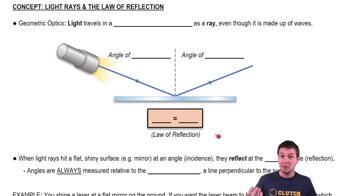
Law of Reflection

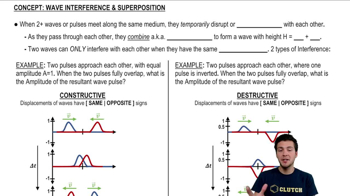
Interference of Light

Interference occurs when two or more light waves overlap, resulting in a new wave pattern. In the context of optical coatings, constructive and destructive interference can be manipulated to enhance or reduce reflection at specific wavelengths. For a coating designed to minimize reflection at a certain wavelength, it will effectively cancel out the reflected waves through destructive interference, while other wavelengths may not experience the same effect.
추천 영상:
03:47
Wave Interference & Superposition

Wavelength Dependence

The behavior of light, including reflection and transmission, is highly dependent on its wavelength. Different wavelengths interact with materials in unique ways, leading to variations in intensity and phase. In the given question, the coating is optimized for λ = 550 nm, meaning its effectiveness at λ = 430 nm and λ = 670 nm will differ, necessitating an analysis of how the coating's properties affect these wavelengths.
추천 영상:
05:42
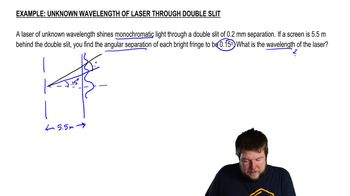
Unknown Wavelength of Laser through Double Slit
관련 실천
교과서 질문

Light of wavelength 5.0 x 10⁻⁷ passes through two parallel slits and falls on a screen 5.0 m away. Adjacent bright bands of the interference pattern are 2.0 cm apart.

(a) Find the distance between the slits.

(b) The same two slits are next illuminated by light of a different wavelength, and the fifth minimum for this light occurs at the same point on the screen as the fourth minimum for the previous light. What is the wavelength of the second source of light?

60
views
교과서 질문

A uniform thin film of alcohol (n = 1.36) lies on a flat glass plate (n = 1.56). When monochromatic light, whose wavelength can be changed, is incident normally, the reflected light is a minimum for λ = 492 nm and a maximum for λ = 615 nm. What is the minimum thickness of the film?

3
views
교과서 질문

Show that the radius r of the mᵗʰ dark Newton’s ring, as viewed from directly above (Fig. 34–18), is given by r = √mλR where R is the radius of curvature of the curved glass surface and λ is the wavelength of light used. Assume that the thickness of the air gap is much less than R at all points and that r ≪ R . [Hint: Use the binomial expansion.]

125
views
교과서 질문

What would Brewster’s angle be for reflections off the surface of water for light coming from beneath the surface? Compare to the angle for total internal reflection, and to Brewster’s angle from above the surface.

1338
views
교과서 질문

What is Brewster’s angle for an air-glass (n = 1.56) surface? Specify two answers.

1476
views
교과서 질문

(II) When a Newton’s ring apparatus (Fig. 34–18) is immersed in a liquid, the diameter of the tenth dark ring decreases from 2.92 cm to 2.54 cm. What is the refractive index of the liquid? [Hint: See Problem 37.]

62
views