Ch. 34 - The Wave Nature of Light: Interference and Polarization
Giancoli Douglas - Physics for Scientists and Engineers 5th edition
Giancoli Douglas5th editionPhysics for Scientists and EngineersISBN: 9780137488179당신이 사용하는 게 아니라요?교과서 변경
33장, 문제 37

Show that the radius r of the mᵗʰ dark Newton’s ring, as viewed from directly above (Fig. 34–18), is given by r = √mλR where R is the radius of curvature of the curved glass surface and λ is the wavelength of light used. Assume that the thickness of the air gap is much less than R at all points and that r ≪ R . [Hint: Use the binomial expansion.]

검증된 단계별 안내
1
Start by understanding the setup: Newton's rings are formed due to the interference of light reflected from the top and bottom surfaces of the thin air film between a curved glass surface and a flat glass plate. The condition for destructive interference (dark rings) is that the optical path difference equals an odd multiple of half the wavelength.
The optical path difference for the mᵗʰ dark ring is given by: 2t = (m + 1/2)λ, where t is the thickness of the air film at the radius r, λ is the wavelength of light, and m is the ring number (m = 0, 1, 2, ...).
For small thickness t, the geometry of the curved surface gives the relationship: t ≈ r² / (2R), where r is the radius of the ring and R is the radius of curvature of the curved glass surface. Substitute this expression for t into the interference condition.
After substitution, the equation becomes: 2(r² / (2R)) = (m + 1/2)λ. Simplify this equation to isolate r², which gives: r² = mλR (neglecting the +1/2 term for large m, as it becomes negligible).
Finally, take the square root of both sides to solve for r: r = √(mλR). This is the desired expression for the radius of the mᵗʰ dark Newton's ring.

비슷한 문제에 대한 검증된 영상 답변:

이 영상 해법은 위 문제에 도움이 된다고 튜터들이 추천한 것입니다.
영상 길이:
8m
도움이 되었나요?

주요 개념

질문에 올바르게 답하기 위해 반드시 이해해야 하는 핵심 개념들은 다음과 같습니다.

Newton's Rings

Newton's rings are a series of concentric circular interference patterns created by the reflection of light between a flat glass plate and a convex lens. The rings result from the varying thickness of the air gap between the two surfaces, leading to constructive and destructive interference of light waves. The radius of these rings can be mathematically related to the wavelength of light and the curvature of the lens.
추천 영상:
가이드 코스
04:27
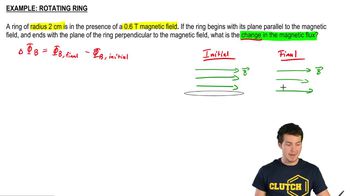
Magnetic Flux of a Rotating Ring

Interference of Light

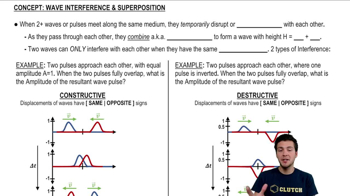
Interference occurs when two or more light waves overlap and combine, resulting in a new wave pattern. This phenomenon can be constructive, where waves reinforce each other, or destructive, where they cancel each other out. The conditions for interference depend on the path difference between the waves, which is crucial for understanding the formation of Newton's rings.
추천 영상:
가이드 코스
03:47
Wave Interference & Superposition

Binomial Expansion

The binomial expansion is a mathematical technique used to expand expressions that are raised to a power, particularly useful when dealing with approximations. In the context of Newton's rings, it allows for simplifying expressions involving the radius of curvature and the small thickness of the air gap. This simplification is essential for deriving the relationship between the radius of the mᵗʰ dark ring, the wavelength of light, and the radius of curvature.
추천 영상:
가이드 코스
05:21
Volume Thermal Expansion