Ch. 34 - The Wave Nature of Light: Interference and Polarization
Giancoli Douglas - Physics for Scientists and Engineers 5th edition
Giancoli Douglas5th editionPhysics for Scientists and EngineersISBN: 9780137488179당신이 사용하는 게 아니라요?교과서 변경
33장, 문제 5

(II) Assume that light of a single color, rather than white light, passes through the two-slit setup described in Example 34–4. If the distance from the central fringe to a first-order fringe is measured to be 2.9 mm on the screen, determine the light’s wavelength (in nm) and color (see Fig. 34–11).

검증된 단계별 안내
1
Step 1: Understand the problem setup. The two-slit experiment involves light passing through two narrow slits and forming an interference pattern on a screen. The distance from the central fringe (bright spot) to the first-order fringe (next bright spot) is given as 2.9 mm. We need to determine the wavelength of the light and its corresponding color.
Step 2: Recall the formula for the position of the m-th order fringe in a two-slit interference pattern: \( y_m = \frac{m \lambda L}{d} \), where \( y_m \) is the distance from the central fringe to the m-th order fringe, \( m \) is the fringe order (here, \( m = 1 \)), \( \lambda \) is the wavelength of the light, \( L \) is the distance from the slits to the screen, and \( d \) is the distance between the slits.
Step 3: Rearrange the formula to solve for the wavelength \( \lambda \): \( \lambda = \frac{y_m d}{m L} \). Substitute \( m = 1 \) since we are dealing with the first-order fringe.
Step 4: Identify the values needed for the calculation. From the problem, \( y_1 = 2.9 \, \text{mm} = 2.9 \times 10^{-3} \, \text{m} \). The values for \( L \) (distance to the screen) and \( d \) (distance between the slits) should be provided in Example 34–4 or Fig. 34–11. If not, refer to standard experimental setups for typical values.
Step 5: Once \( \lambda \) is calculated, convert it to nanometers (1 nm = \( 10^{-9} \) m). Use the wavelength to determine the color of the light by comparing it to the visible spectrum (e.g., red light is approximately 620–750 nm, violet light is approximately 380–450 nm).

비슷한 문제에 대한 검증된 영상 답변:

이 영상 해법은 위 문제에 도움이 된다고 튜터들이 추천한 것입니다.
영상 길이:
7m
도움이 되었나요?

주요 개념

질문에 올바르게 답하기 위해 반드시 이해해야 하는 핵심 개념들은 다음과 같습니다.

Young's Double-Slit Experiment

Young's Double-Slit Experiment demonstrates the wave nature of light through interference patterns created when light passes through two closely spaced slits. The resulting pattern consists of alternating bright and dark fringes on a screen, where bright fringes correspond to constructive interference and dark fringes to destructive interference. The distance between these fringes is related to the wavelength of the light used.
추천 영상:
12:00
Young's Double Slit Experiment

Wavelength of Light

The wavelength of light is the distance between successive peaks of a light wave, typically measured in nanometers (nm). It is a fundamental property that determines the color of light; shorter wavelengths correspond to blue/violet light, while longer wavelengths correspond to red light. In the context of the double-slit experiment, the wavelength can be calculated using the fringe spacing and the geometry of the setup.
추천 영상:
가이드 코스
10:30
Ray Nature of Light

Interference Pattern Calculation

To determine the wavelength of light from the interference pattern, one can use the formula for the position of the fringes: y = (mλL) / d, where y is the distance from the central maximum to the m-th order fringe, λ is the wavelength, L is the distance from the slits to the screen, and d is the distance between the slits. By rearranging this formula, the wavelength can be calculated if the fringe distance and other parameters are known.
추천 영상:
03:47
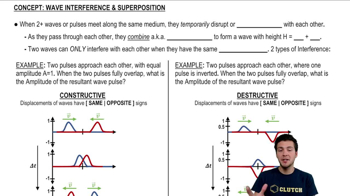
Wave Interference & Superposition