Ch. 34 - The Wave Nature of Light: Interference and Polarization
Giancoli Douglas - Physics for Scientists and Engineers 5th edition
Giancoli Douglas5th editionPhysics for Scientists and EngineersISBN: 9780137488179당신이 사용하는 게 아니라요?교과서 변경
33장, 문제 13

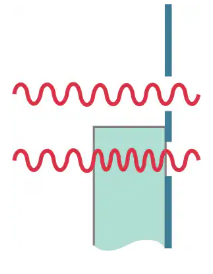
(II) Suppose a thin piece of glass is placed in front of the lower slit in Fig. 34–7 so that the two waves enter the slits 180° out of phase (Fig. 34–44). Describe in detail the interference pattern on the screen.

검증된 단계별 안내
1
Understand the setup: The problem involves a double-slit interference experiment where a thin piece of glass is placed in front of the lower slit. This introduces a phase difference of 180° (or π radians) between the two waves entering the slits. This phase difference will affect the interference pattern on the screen.
Recall the principle of interference: In a double-slit experiment, the interference pattern on the screen is determined by the constructive and destructive interference of the waves from the two slits. Constructive interference occurs when the path difference between the waves is an integer multiple of the wavelength (nλ), while destructive interference occurs when the path difference is an odd multiple of half the wavelength ((2n+1)λ/2).
Account for the phase shift: The 180° phase shift introduced by the glass effectively inverts the conditions for constructive and destructive interference. This means that points on the screen that would normally experience constructive interference will now experience destructive interference, and vice versa.
Describe the new pattern: The central maximum (bright fringe) in the original pattern will now become a dark fringe due to the phase shift. Similarly, the positions of all other bright and dark fringes will be swapped. The spacing between the fringes will remain the same, as it depends on the wavelength of the light and the geometry of the setup, which are unchanged.
Summarize the result: The interference pattern on the screen will appear inverted compared to the original pattern. Bright and dark fringes will exchange places, but the overall spacing and symmetry of the pattern will remain unchanged.

비슷한 문제에 대한 검증된 영상 답변:

이 영상 해법은 위 문제에 도움이 된다고 튜터들이 추천한 것입니다.
영상 길이:
5m

주요 개념

질문에 올바르게 답하기 위해 반드시 이해해야 하는 핵심 개념들은 다음과 같습니다.

Wave Interference

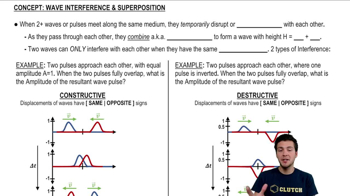
Wave interference occurs when two or more waves overlap and combine to form a new wave pattern. This can result in constructive interference, where waves are in phase and amplify each other, or destructive interference, where waves are out of phase and cancel each other out. Understanding this concept is crucial for analyzing how waves interact, particularly in the context of light waves passing through slits.
추천 영상:
가이드 코스
03:47
Wave Interference & Superposition

Phase Difference

Phase difference refers to the difference in the phase of two waves at a given point in time. In this scenario, a phase difference of 180° means that the waves are completely out of phase, leading to destructive interference. This concept is essential for predicting the resulting intensity pattern on the screen, as it determines whether the waves will reinforce or cancel each other.
추천 영상:
가이드 코스
08:59
Phase Constant of a Wave Function

Interference Pattern

An interference pattern is the pattern of light and dark regions created on a screen when waves interfere with each other. In the case of the glass causing a 180° phase shift, the resulting pattern will show dark fringes where destructive interference occurs, indicating points of cancellation. This pattern is a direct visual representation of the wave behavior and is fundamental in experiments like the double-slit experiment.
추천 영상:
가이드 코스
03:47
Wave Interference & Superposition
관련 실천
교과서 질문

Monochromatic light falling on two slits 0.018 mm apart produces the fifth-order bright fringe at a 12° angle. What is the wavelength of the light used?

1529
views

교과서 질문

(II) Light of wavelength λ passes through a pair of slits separated by 0.17 mm, forming a double-slit interference pattern on a screen located a distance 35 cm away. Suppose that the image in Fig. 34–9a is an actual-size reproduction of this interference pattern. Use a ruler to measure a pertinent distance on this image; then utilize this measured value to determine λ (nm) .

1479
views
교과서 질문

(II) Assume that light of a single color, rather than white light, passes through the two-slit setup described in Example 34–4. If the distance from the central fringe to a first-order fringe is measured to be 2.9 mm on the screen, determine the light’s wavelength (in nm) and color (see Fig. 34–11).

1307
views
교과서 질문

Consider three equally spaced and equal-intensity coherent sources of light (such as adding a third slit to the two slits of Fig. 34–12). Determine the positions of minima.

1080
views
교과서 질문

In a two-slit interference experiment, the path length to a certain point P on the screen differs for one slit in comparison with the other by 1.25λ.

(a) What is the phase difference between the two waves arriving at point P?

(b) Determine the intensity at P, expressed as a fraction of the maximum intensity Iₒ on the screen.

1550
views
교과서 질문

Suppose that one slit of a double-slit apparatus is wider than the other so that the intensity of light passing through it is twice as great. Determine the intensity I as a function of position (θ) on the screen for coherent light.

1335
views