Ch 01: Concepts of Motion
Knight Calc - Physics for Scientists and Engineers 5th Edition
Knight Calc5th EditionPhysics for Scientists and EngineersISBN: 9780137344796당신이 사용하는 게 아니라요?교과서 변경
1장, 문제 57a

The quantity called mass density is the mass per unit volume of a substance. What are the mass densities in basic SI units of the following objects? A 215 cm3 solid with a mass of 0.0179 kg.

검증된 단계별 안내
1
Convert the volume of the solid from cm³ to m³. Since 1 cm³ = 1 × 10⁻⁶ m³, multiply the given volume (215 cm³) by 1 × 10⁻⁶ to express it in cubic meters.
Recall the formula for mass density: ρ = m / V, where ρ is the mass density, m is the mass, and V is the volume.
Substitute the given mass (0.0179 kg) and the converted volume (in m³) into the formula for mass density.
Simplify the expression to calculate the mass density in kg/m³, which is the SI unit for mass density.
Verify the units of the final result to ensure they are consistent with the SI system (kg/m³).

비슷한 문제에 대한 검증된 영상 답변:

이 영상 해법은 위 문제에 도움이 된다고 튜터들이 추천한 것입니다.
영상 길이:
1m
도움이 되었나요?

주요 개념

질문에 올바르게 답하기 위해 반드시 이해해야 하는 핵심 개념들은 다음과 같습니다.

Mass Density

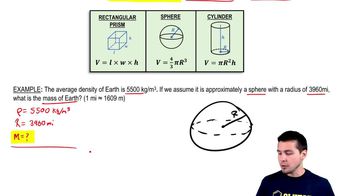
Mass density is defined as the mass of a substance divided by its volume. It is a measure of how much mass is contained in a given volume and is typically expressed in kilograms per cubic meter (kg/m³) in the SI system. Understanding mass density is crucial for determining how substances interact, as it influences buoyancy, stability, and material properties.
추천 영상:
가이드 코스
04:33
Problems with Mass, Volume, & Density

SI Units

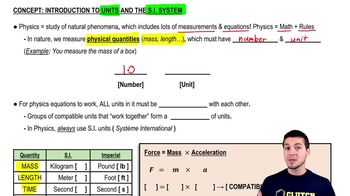
The International System of Units (SI) is the standard system of measurement used in science and engineering. It provides a consistent framework for measuring physical quantities, including mass (kilograms), volume (cubic meters), and density (kilograms per cubic meter). Familiarity with SI units is essential for accurate calculations and comparisons in physics.
추천 영상:
가이드 코스
03:18
Introduction to Units & the SI System

Volume Calculation

Volume is the amount of space occupied by an object and is a critical component in calculating mass density. For irregular shapes, volume can be determined through methods such as water displacement, while regular shapes use geometric formulas. In this question, the volume of the solid is given in cubic centimeters, which must be converted to cubic meters to align with SI units for density calculations.
추천 영상:
가이드 코스
05:21
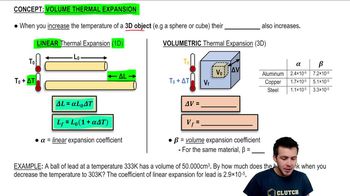
Volume Thermal Expansion