뒤로
뒤로
문제 1b
An air-track glider is attached to a spring. The glider is pulled to the right and released from rest at t = 0 s. It then oscillates with a period of 2.0 s and a maximum speed of 40 cm/s. What is the glider's position at t = 0.25 s?
문제 3
An object in SHM oscillates with a period of 4.0 s and an amplitude of 10 cm. How long does the object take to move from x = 0.0 cm to x = 6.0 cm?
문제 4
When a guitar string plays the note 'A,' the string vibrates at 440 Hz. What is the period of the vibration?
문제 6
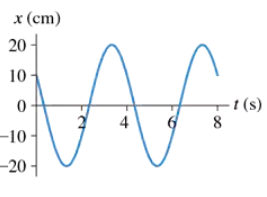
What are the (a) amplitude, (b) frequency, and (c) phase constant of the oscillation shown in FIGURE EX15.6?
문제 7a
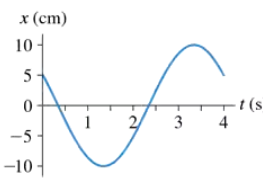
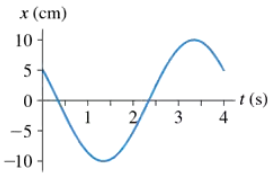
FIGURE EX15.7 is the position-versus-time graph of a particle in simple harmonic motion. What is the phase constant?
문제 7c
FIGURE EX15.7 is the position-versus-time graph of a particle in simple harmonic motion. What is vmax?
문제 10
An object in simple harmonic motion has an amplitude of 8.0 cm, n angular frequency of 0.25 rad/s, and a phase constant of π rad. Draw a velocity graph showing two cycles of the motion.
문제 13a
An air-track glider attached to a spring oscillates with a period of 1.5 s. At t = 0 s the glider is 5.00 cm left of the equilibrium position and moving to the right at 36.3 cm/s. What is the phase constant?
문제 14
A 200 g air-track glider is attached to a spring. The glider is pushed in 10 cm and released. A student with a stopwatch finds that 10 oscillations take 12.0 s. What is the spring constant?
문제 15c
A block attached to a spring with unknown spring constant oscillates with a period of 2.0 s. What is the period if the amplitude is doubled?
문제 15d
A block attached to a spring with unknown spring constant oscillates with a period of 2.0 s. What is the period if The spring constant is doubled? Parts a to d are independent questions, each referring to the initial situation.
문제 16e
A 200 g mass attached to a horizontal spring oscillates at a frequency of 2.0 Hz. At t = 0 s, the mass is at x = 5.0 cm and has vx = -30 cm/s. Determine: The maximum speed.
문제 16g
A 200 g mass attached to a horizontal spring oscillates at a frequency of 2.0 Hz. At t = 0 s, the mass is at x = 5.0 cm and has vₓ = -30 cm/s. Determine: The total energy.
문제 16h
A 200 g mass attached to a horizontal spring oscillates at a frequency of 2.0 Hz. At t = 0 s, the mass is at x = 5.0 cm and has vx = -30 cm/s. Determine: The position at t = 0.40 s.
문제 17e
The position of a 50 g oscillating mass is given by 𝓍(t) = (2.0 cm) cos (10 t - π/4), where t is in s. Determine: The initial conditions.
문제 17h
The position of a 50 g oscillating mass is given by 𝓍(t) = (2.0 cm) cos (10 t - π/4), where t is in s. Determine: The velocity at t = 0.40 s.
문제 18b
A 1.0 kg block is attached to a spring with spring constant 16 N/m. While the block is sitting at rest, a student hits it with a hammer and almost instantaneously gives it a speed of 40 cm/s. What are The block's speed at the point where 𝓍 = (½)A?
문제 19a
A 500 g air-track glider moving at 0.50 m/s collides with a horizontal spring whose opposite end is anchored to the end of the track. Measurements show that the glider is in contact with the spring for 1.5 s before it rebounds. What is the value of the spring constant?
문제 19b
A 500 g air-track glider moving at 0.50 m/s collides with a horizontal spring whose opposite end is anchored to the end of the track. Measurements show that the glider is in contact with the spring for 1.5 s before it rebounds. What is the maximum compression of the spring?
문제 21b
A spring is hanging from the ceiling. Attaching a 500 g physics book to the spring causes it to stretch 20 cm in order to come to equilibrium. From equilibrium, the book is pulled down 10 cm and released. What is the period of oscillation?
문제 21c
A spring is hanging from the ceiling. Attaching a 500 g physics book to the spring causes it to stretch 20 cm in order to come to equilibrium. What is the book's maximum speed?
문제 22
A spring is hung from the ceiling. When a block is attached to its end, it stretches 2.0 cm before reaching its new equilibrium length. The block is then pulled down slightly and released. What is the frequency of oscillation?
문제 25
A pendulum is made by tying a 75 g ball to a 130-cm-long string. The ball is pulled 5.0° to the side and released. How many times does the ball pass through the lowest point of its arc in 7.5 s?
문제 28
A pendulum on a 75-cm-long string has a maximum speed of 0.25 m/s. What is the pendulum's maximum angle in degrees?
문제 30
Astronauts on the first trip to Mars take along a pendulum that has a period on earth of 1.50 s. The period on Mars turns out to be 2.45 s. What is the free-fall acceleration on Mars?
문제 33
In a science museum, a 110 kg brass pendulum bob swings at the end of a 15.0-m-long wire. The pendulum is started at exactly 8:00 a.m. every morning by pulling it 1.5 m to the side and releasing it. Because of its compact shape and smooth surface, the pendulum's damping constant is only 0.010 kg/s. At exactly 12:00 noon, how many oscillations will the pendulum have completed and what is its amplitude?
문제 34
The amplitude of an oscillator decreases to 36.8% of its initial value in 10.0 s. What is the value of the time constant?
문제 35
Vision is blurred if the head is vibrated at 29 Hz because the vibrations are resonant with the natural frequency of the eyeball in its socket. If the mass of the eyeball is 7.5 g, a typical value, what is the effective spring constant of the musculature that holds the eyeball in the socket?
문제 36
A 350 g mass on a 45-cm-long string is released at an angle of 4.5° from vertical. It has a damping constant of 0.010 kg/s. After 25 s, (a) how many oscillations has it completed and (b) what fraction of the initial energy has been lost?
문제 38
Two 500 g air-track gliders are each connected by identical springs with spring constant 25 N/m to the ends of the air track. The gliders are connected to each other by a spring with spring constant 2.0 N/m. One glider is pulled 8.0 cm to the side and released while the other is at rest at its equilibrium position. How long will it take until the glider that was initially at rest has all the motion while the first glider is at rest?