뒤로
뒤로
문제 1
The electric field strength is 50,000 N/C inside a parallel-plate capacitor with a 2.0 mm spacing. A proton is released from rest at the positive plate. What is the proton's speed when it reaches the negative plate?
문제 4
An electron is released from rest at the center of a parallel-plate capacitor that has a 1.0 mm spacing. The electron then strikes one of the plates with a speed of 1.5×10⁶ m/s. What is the electric field strength inside the capacitor?
문제 5
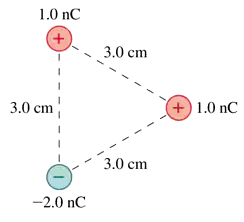
What is the electric potential energy of the group of charges in FIGURE EX25.5?
문제 7
Two positive point charges are 5.0 cm apart. If the electric potential energy is 72 μJ, what is the magnitude of the force between the two charges?
문제 8
Three charged particles are placed at the corners of an equilateral triangle that has edge length 2.0 cm. One particle has charge +3.0 nC and a second has charge +6.0 nC. What is the third charge if the electric potential energy of the three charged particles is zero?
문제 10a
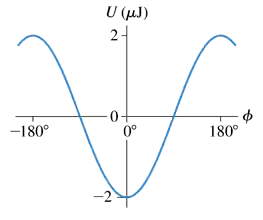
FIGURE EX25.10 shows the potential energy of an electric dipole. Consider a dipole that oscillates between ±60°. What is the dipole's mechanical energy?
문제 11
What is the speed of an electron that has been accelerated from rest through a potential difference of 1000 V?
문제 14
What potential difference is needed to accelerate an electron from rest to a speed of 2.0×10⁶ m/s?
문제 15b
A proton with an initial speed of 800,000 m/s is brought to rest by an electric field. What was the potential difference that stopped the proton?
문제 16a
An electron with an initial speed of 500,000 m/s is brought to rest by an electric field. Did the electron move into a region of higher potential or lower potential?
문제 17
In proton-beam therapy, a high-energy beam of protons is fired at a tumor. As the protons stop in the tumor, their kinetic energy breaks apart the tumor's DNA, thus killing the tumor cells. For one patient, it is desired to deposit 0.10 J of proton energy in the tumor. To create the proton beam, protons are accelerated from rest through a 10,000 kV potential difference. What is the total charge of the protons that must be fired at the tumor?
문제 18
A 250 pg dust particle has charge −250e. Its speed is 2.0 m/s at point 1, where the electric potential is V₁=2000 V. What speed will it have at point 2, where the potential is V₂=−5000 V? Ignore air resistance and gravity.
문제 20b
A student wants to make a very small particle accelerator using a 9.0 V battery. What speed will an electron have after being accelerated from rest through the 9.0 V potential difference?
문제 22a
A 3.0-cm-diameter parallel-plate capacitor has a 2.0 mm spacing. The electric field strength inside the capacitor is 1.0×10⁵ V/m. What is the potential difference across the capacitor?
문제 22b
A 3.0-cm-diameter parallel-plate capacitor has a 2.0 mm spacing. The electric field strength inside the capacitor is 1.0×10⁵ V/m. How much charge is on each plate?
문제 23a
Two 2.00 cm×2.00 cm plates that form a parallel-plate capacitor are charged to ±0.708 nC. What are the electric field strength inside and the potential difference across the capacitor if the spacing between the plates is 1.00 mm?
문제 24b
Two 2.0-cm-diameter disks spaced 2.0 mm apart form a parallel-plate capacitor. The electric field between the disks is 5.0×10⁵ V/m. An electron is launched from the negative plate. It strikes the positive plate at a speed of 2.0×10⁷ m/s. What was the electron's speed as it left the negative plate?
문제 27b
What are the potential differences ΔVₐᵦ=Vᵦ−Vₐ and ΔV𝒸ᵦ=Vᵦ−V𝒸?
문제 28
A 1.0-mm-diameter ball bearing has 2.0×10⁹ excess electrons. What is the ball bearing's potential?
문제 29a
In a semiclassical model of the hydrogen atom, the electron orbits the proton at a distance of 0.053 nm. What is the electric potential of the proton at the position of the electron?
문제 29b
In a semiclassical model of the hydrogen atom, the electron orbits the proton at a distance of 0.053 nm. What is the electron's potential energy?
문제 31
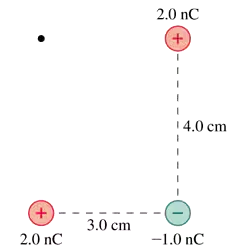
What is the electric potential at the point indicated with the dot in FIGURE EX25.31?
문제 33
Two small charged spheres are 5.0 cm apart. One is charged to +25 nC, the other to −15 nC. A proton is released from rest halfway between the spheres. What is the proton's speed after it has moved 1.0 cm?
문제 34
Four small spheres, each charged to +15 nC, form a square 2.0 cm on each side. From far away, a proton is shot toward the square along a line perpendicular to the square and passing through its center. What minimum initial speed does the proton need to pass through the square of charges?
문제 35
The two halves of the rod in FIGURE EX25.35 are uniformly charged to ±Q. What is the electric potential at the point indicated by the dot?
문제 36b
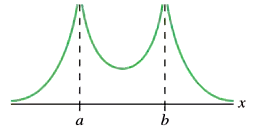
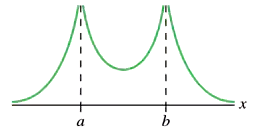
Two point charges qₐ and qᵦ are located on the x-axis at x=a and x=b. FIGURE EX25.36 is a graph of V, the electric potential. What is the ratio |qₐ/qᵦ|?
문제 36c
Two point charges qₐ and qᵦ are located on the x-axis at x=a and x=b. FIGURE EX25.36 is a graph of V, the electric potential. Draw a graph of Eₓ, the x-component of the electric field, as a function of x.
문제 37
Two point charges 2.0 cm apart have an electric potential energy −180 μJ. The total charge is 30 nC. What are the two charges?
문제 38a
A −10.0 nC point charge and a +20.0 nC point charge are 15.0 cm apart on the x-axis. What is the electric potential at the point on the x-axis where the electric field is zero?
문제 39
A +3.0 nC charge is at x=0 cm and a −1.0 nC charge is at x=4 cm. At what point or points on the x-axis is the electric potential zero?