
Ch 02: Kinematics in One Dimension
Knight Calc - Physics for Scientists and Engineers 5th Edition
Knight Calc5th EditionPhysics for Scientists and EngineersISBN: 9780137344796당신이 사용하는 게 아니라요?교과서 변경
2장, 문제 55

A 1000 kg weather rocket is launched straight up. The rocket motor provides a constant acceleration for 16 s, then the motor stops. The rocket altitude 20 s after launch is 5100 m. You can ignore any effects of air resistance. What was the rocket's acceleration during the first 16 s?

검증된 단계별 안내
1
Step 1: Break the motion into two phases: (1) the first 16 seconds when the rocket is under constant acceleration due to the motor, and (2) the remaining 4 seconds when the rocket is in free fall under the influence of gravity only. Use kinematic equations to analyze each phase.
Step 2: For the first phase (0 to 16 s), use the kinematic equation: s=ut+12at2, where s is the displacement, u is the initial velocity (0 m/s), t is the time (16 s), and a is the acceleration. This will give the altitude at the end of the first phase.
Step 3: For the second phase (16 to 20 s), the rocket is in free fall. The initial velocity for this phase is the final velocity from the first phase, which can be calculated using the equation: v=u+at. Use this velocity as the initial velocity for the second phase and apply the kinematic equation: s=ut+12at2, where a is now -g (acceleration due to gravity, approximately 9.8 m/s2).
Step 4: Add the displacements from both phases to find the total altitude of the rocket at 20 seconds. Set this equal to the given altitude of 5100 m and solve for the unknown acceleration a during the first phase.
Step 5: Rearrange the equations algebraically to isolate a and solve for it. This will give the rocket's acceleration during the first 16 seconds.

비슷한 문제에 대한 검증된 영상 답변:

이 영상 해법은 위 문제에 도움이 된다고 튜터들이 추천한 것입니다.
영상 길이:
12m
도움이 되었나요?

주요 개념

질문에 올바르게 답하기 위해 반드시 이해해야 하는 핵심 개념들은 다음과 같습니다.

Newton's Second Law of Motion

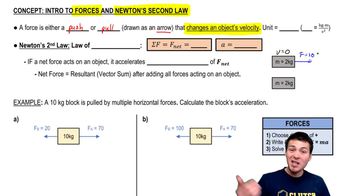
Newton's Second Law states that the acceleration of an object is directly proportional to the net force acting on it and inversely proportional to its mass. This relationship is expressed by the formula F = ma, where F is the net force, m is the mass, and a is the acceleration. In the context of the rocket, this law helps determine the force exerted by the rocket motor and the resulting acceleration.
추천 영상:
가이드 코스
06:54
Intro to Forces & Newton's Second Law

Kinematic Equations

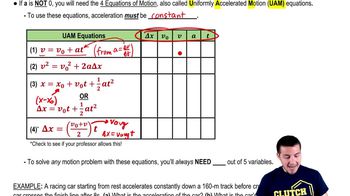
Kinematic equations describe the motion of objects under constant acceleration. They relate displacement, initial velocity, final velocity, acceleration, and time. For the rocket, these equations can be used to calculate the distance traveled during the first 16 seconds of acceleration and to analyze its motion after the motor stops.
추천 영상:
가이드 코스
08:25
Kinematics Equations

Free Fall and Gravity

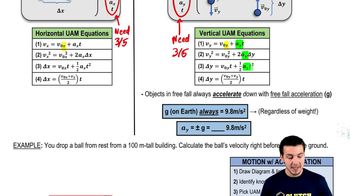
Free fall refers to the motion of an object under the influence of gravity alone, with no other forces acting on it. On Earth, the acceleration due to gravity is approximately 9.81 m/s² downward. After the rocket motor stops, the rocket will experience free fall, and understanding this concept is crucial for calculating its altitude and velocity during the second phase of its flight.
추천 영상:
가이드 코스
08:36
Vertical Motion & Free Fall
관련 실천
교과서 질문

A cheetah spots a Thomson's gazelle, its preferred prey, and leaps into action, quickly accelerating to its top speed of 30 m/s, the highest of any land animal. However, a cheetah can maintain this extreme speed for only 15 s before having to let up. The cheetah is 170 m from the gazelle as it reaches top speed, and the gazelle sees the cheetah at just this instant. With negligible reaction time, the gazelle heads directly away from the cheetah, accelerating at 4.6 m/s² for 5.0 s, then running at constant speed. Does the gazelle escape? If so, by what distance is the gazelle in front when the cheetah gives up?

2461
views
1
rank
교과서 질문

Find an expression for the minimum stopping distance dstop of a car traveling at speed v0 if the driver's reaction time is Treact and the magnitude of the acceleration during maximum braking is a constant abrake.

2264
views
교과서 질문

A 200 kg weather rocket is loaded with 100 kg of fuel and fired straight up. It accelerates upward at 30 m/s² for 30 s, then runs out of fuel. Ignore any air resistance effects. What is the rocket's maximum altitude?

3033
views
교과서 질문

A hotel elevator ascends 200 m with a maximum speed of 5.0 m/s. Its acceleration and deceleration both have a magnitude of 1.0 m/s2. How long does it take to make the complete trip from bottom to top?

1792
views
교과서 질문

A lead ball is dropped into a lake from a diving board 5.0 m above the water. After entering the water, it sinks to the bottom with a constant velocity equal to the velocity with which it hit the water. The ball reaches the bottom 3.0 s after it is released. How deep is the lake?

2825
views
교과서 질문

A car starts from rest at a stop sign. It accelerates at 4.0 m/s² for 6.0 s, coasts for 2.0 s, and then slows down at a rate of 3.0 m/s² for the next stop sign. How far apart are the stop signs?

3292
views