Ch 02: Kinematics in One Dimension
Knight Calc - Physics for Scientists and Engineers 5th Edition
Knight Calc5th EditionPhysics for Scientists and EngineersISBN: 9780137344796당신이 사용하는 게 아니라요?교과서 변경
2장, 문제 21a

A rock is tossed straight up from ground level with a speed of 20 m/s. When it returns, it falls into a hole 10 m deep. What is the rock's speed as it hits the bottom of the hole?

검증된 단계별 안내
1
Identify the known values: The initial velocity \( v_0 \) is 20 m/s (upward), the displacement \( s \) is -10 m (since the rock ends up 10 m below the starting point), and the acceleration due to gravity \( a \) is -9.8 m/s² (negative because it acts downward).
Use the kinematic equation \( v^2 = v_0^2 + 2as \) to find the final velocity \( v \) of the rock when it hits the bottom of the hole. Here, \( v_0 \) is the initial velocity, \( a \) is the acceleration, and \( s \) is the displacement.
Substitute the known values into the equation: \( v^2 = (20)^2 + 2(-9.8)(-10) \). Simplify the terms inside the equation to prepare for solving for \( v \).
Take the square root of both sides of the equation to solve for \( v \): \( v = \sqrt{v^2} \). Remember that the final velocity will be positive because we are looking for the magnitude of the speed as it hits the bottom of the hole.
Interpret the result: The calculated \( v \) represents the speed of the rock just before it hits the bottom of the hole. Ensure the units are consistent (m/s) and verify the calculation aligns with the physical scenario.

비슷한 문제에 대한 검증된 영상 답변:

이 영상 해법은 위 문제에 도움이 된다고 튜터들이 추천한 것입니다.
영상 길이:
5m
도움이 되었나요?

주요 개념

질문에 올바르게 답하기 위해 반드시 이해해야 하는 핵심 개념들은 다음과 같습니다.

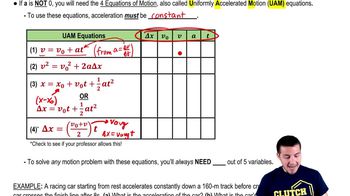
Kinematics

Kinematics is the branch of physics that describes the motion of objects without considering the forces that cause the motion. It involves concepts such as displacement, velocity, acceleration, and time. In this problem, kinematic equations can be used to relate the initial speed of the rock, the height it reaches, and its final speed when it hits the bottom of the hole.
추천 영상:
가이드 코스
08:25
Kinematics Equations

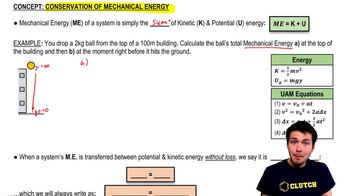
Conservation of Energy

The principle of conservation of energy states that energy cannot be created or destroyed, only transformed from one form to another. In this scenario, the rock's initial kinetic energy when tossed upwards is converted into gravitational potential energy at its highest point and then back into kinetic energy as it falls. This principle helps in calculating the speed of the rock just before it impacts the bottom of the hole.
추천 영상:
가이드 코스
06:24
Conservation Of Mechanical Energy

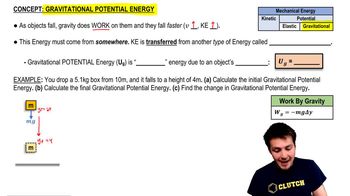
Gravitational Potential Energy

Gravitational potential energy (GPE) is the energy an object possesses due to its position in a gravitational field, calculated as GPE = mgh, where m is mass, g is the acceleration due to gravity, and h is height. In this problem, the rock's potential energy at the peak of its trajectory and the depth of the hole are crucial for determining its speed upon impact, as the energy lost in potential energy translates into kinetic energy.
추천 영상:
가이드 코스
06:35
Gravitational Potential Energy