Ch 02: Kinematics in One Dimension
Knight Calc - Physics for Scientists and Engineers 5th Edition
Knight Calc5th EditionPhysics for Scientists and EngineersISBN: 9780137344796당신이 사용하는 게 아니라요?교과서 변경
2장, 문제 31

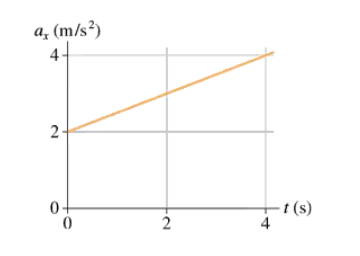
FIGURE EX2.31 shows the acceleration-versus-time graph of a particle moving along the x-axis. Its initial velocity is v0x = 8.0 m/s at t0 = 0 s. What is the particle’s velocity at t = 4.0s?

검증된 단계별 안내
1
Step 1: Understand the relationship between acceleration, velocity, and time. The velocity of a particle can be determined by integrating the acceleration over time. Mathematically, this is expressed as: v(t)=v+0ta(t)dt, where v is the initial velocity, and a(t) is the acceleration as a function of time.
Step 2: Analyze the acceleration-versus-time graph provided in the problem. Break the graph into segments where the acceleration is constant or changes linearly. For each segment, determine the mathematical expression for acceleration or its constant value.
Step 3: Compute the change in velocity for each segment by integrating the acceleration over the corresponding time interval. For a constant acceleration, the change in velocity is given by Δv=a×Δt. For a linearly changing acceleration, use the appropriate integration formula.
Step 4: Add the changes in velocity from all segments to the initial velocity v=8.0 m/s to find the final velocity at t=4.0 s.
Step 5: Verify the units and ensure the final velocity is consistent with the graph's trends. This involves checking that the direction and magnitude of the velocity align with the acceleration's behavior over time.

비슷한 문제에 대한 검증된 영상 답변:

이 영상 해법은 위 문제에 도움이 된다고 튜터들이 추천한 것입니다.
영상 길이:
6m
도움이 되었나요?

주요 개념

질문에 올바르게 답하기 위해 반드시 이해해야 하는 핵심 개념들은 다음과 같습니다.

Acceleration

Acceleration is the rate of change of velocity of an object with respect to time. It is a vector quantity, meaning it has both magnitude and direction. In the context of the acceleration-versus-time graph, the area under the curve represents the change in velocity over a specific time interval.
추천 영상:
가이드 코스
05:47
Intro to Acceleration

Velocity

Velocity is the speed of an object in a specified direction. It is also a vector quantity and can be calculated by integrating acceleration over time. Given the initial velocity and the change in velocity from the acceleration graph, the final velocity can be determined at any point in time.
추천 영상:
가이드 코스
7:27
Escape Velocity

Integration of Acceleration

To find the velocity from an acceleration-time graph, one must integrate the acceleration function over the desired time interval. This process involves calculating the area under the acceleration curve, which directly gives the change in velocity, allowing us to update the initial velocity to find the final velocity at a specific time.
추천 영상:
가이드 코스
11:43
Finding Moment Of Inertia By Integrating