
Ch 02: Kinematics in One Dimension
Knight Calc - Physics for Scientists and Engineers 5th Edition
Knight Calc5th EditionPhysics for Scientists and EngineersISBN: 9780137344796당신이 사용하는 게 아니라요?교과서 변경
2장, 문제 1a

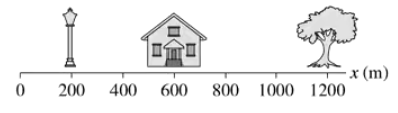
Larry leaves home at 9:05 and runs at constant speed to the lamppost seen in FIGURE EX2.1. He reaches the lamppost at 9:07, immediately turns, and runs to the tree. Larry arrives at the tree at 9:10. What is Larry's average velocity, in, during each of these two intervals?

검증된 단계별 안내
1
Step 1: Understand the problem. Larry's motion is divided into two intervals: (1) from his house to the lamppost, and (2) from the lamppost to the tree. We need to calculate the average velocity for each interval. Average velocity is defined as the displacement divided by the time taken.
Step 2: Analyze the first interval. From the diagram, Larry starts at his house (x = 0 m) and runs to the lamppost (x = 5000 m). The displacement for this interval is Δx = x_final - x_initial = 5000 m - 0 m = 5000 m. The time taken is from 9:05 to 9:07, which is Δt = 2 minutes = 120 seconds.
Step 3: Calculate the average velocity for the first interval using the formula: v_avg = Δx / Δt. Substitute the values: Δx = 5000 m and Δt = 120 s.
Step 4: Analyze the second interval. Larry runs from the lamppost (x = 5000 m) to the tree (x = 2200 m). The displacement for this interval is Δx = x_final - x_initial = 2200 m - 5000 m = -2800 m (negative because he is moving back). The time taken is from 9:07 to 9:10, which is Δt = 3 minutes = 180 seconds.
Step 5: Calculate the average velocity for the second interval using the formula: v_avg = Δx / Δt. Substitute the values: Δx = -2800 m and Δt = 180 s.

비슷한 문제에 대한 검증된 영상 답변:

이 영상 해법은 위 문제에 도움이 된다고 튜터들이 추천한 것입니다.
영상 길이:
3m

주요 개념

질문에 올바르게 답하기 위해 반드시 이해해야 하는 핵심 개념들은 다음과 같습니다.

Average Velocity

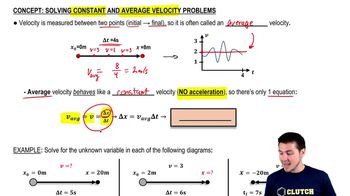
Average velocity is defined as the total displacement divided by the total time taken. It is a vector quantity, meaning it has both magnitude and direction. In this scenario, Larry's average velocity can be calculated for each segment of his run by determining the distance he traveled in each interval and the time taken for that travel.
추천 영상:
가이드 코스
05:44
Solving Constant and Average Velocity Problems

Displacement

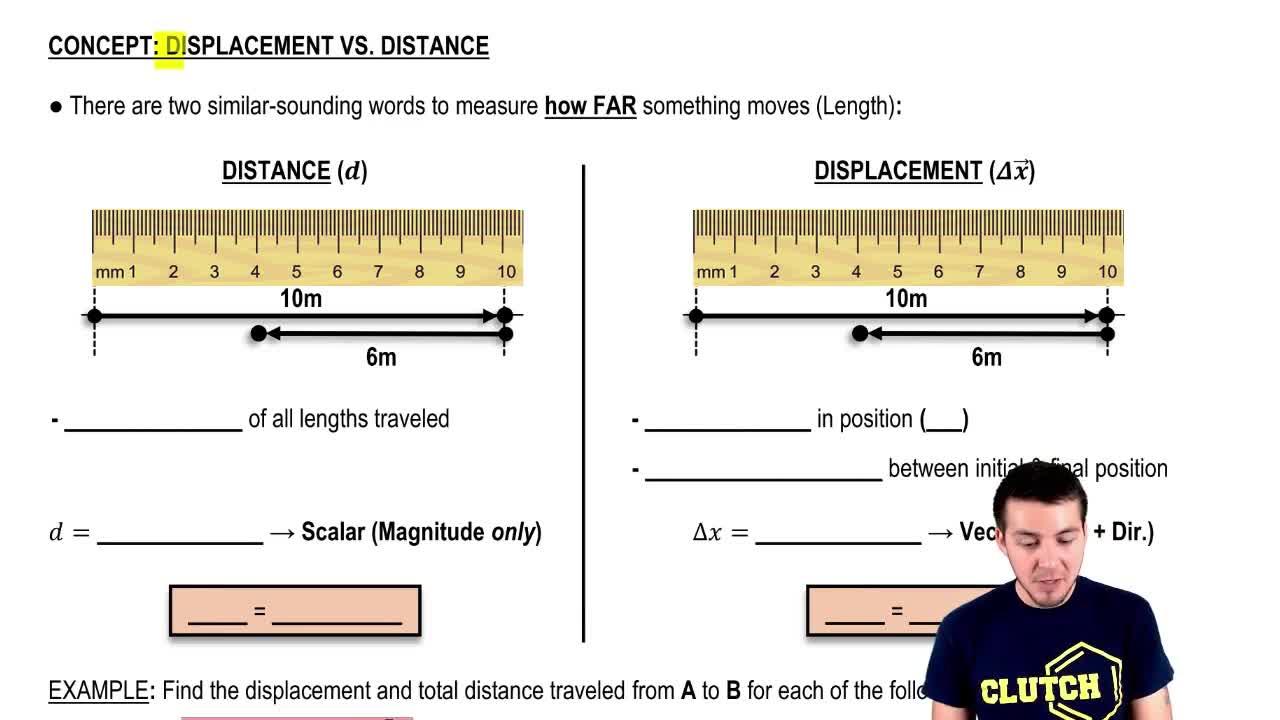
Displacement refers to the change in position of an object and is a vector quantity. It is calculated as the final position minus the initial position. In Larry's case, displacement will be important for determining his average velocity as it considers the straight-line distance from his starting point to his endpoint, regardless of the path taken.
추천 영상:
가이드 코스
06:13
Displacement vs. Distance

Constant Speed

Constant speed means that an object covers equal distances in equal intervals of time, regardless of the direction of travel. In Larry's run, he maintains a constant speed while moving to the lamppost and then to the tree, which simplifies the calculation of average velocity since the speed does not change during each segment of his journey.
추천 영상:
가이드 코스
08:59
Phase Constant of a Wave Function