
Ch 03: Vectors and Coordinate Systems
Knight Calc - Physics for Scientists and Engineers 5th Edition
Knight Calc5th EditionPhysics for Scientists and EngineersISBN: 9780137344796당신이 사용하는 게 아니라요?교과서 변경
3장, 문제 36

Kami is walking through the airport with her two-wheeled suitcase. The suitcase handle is tilted 40° from vertical, and Kami pulls parallel to the handle with a force of 120 N. (Force is measured in newtons, abbreviated N.) What are the horizontal and vertical components of her applied force?

검증된 단계별 안내
1
Identify the given values: The force applied by Kami is 120 N, and the angle of the suitcase handle with respect to the vertical is 40°. The goal is to find the horizontal and vertical components of this force.
Recall the formulas for resolving a force into its components. The horizontal component of the force is given by \( F_x = F \sin(\theta) \), and the vertical component is given by \( F_y = F \cos(\theta) \), where \( F \) is the magnitude of the force and \( \theta \) is the angle from the vertical.
Substitute the given values into the formulas. For the horizontal component: \( F_x = 120 \sin(40°) \). For the vertical component: \( F_y = 120 \cos(40°) \).
Use a scientific calculator or trigonometric tables to evaluate \( \sin(40°) \) and \( \cos(40°) \). Multiply these values by 120 to find the respective components.
The results will give you the horizontal component \( F_x \) and the vertical component \( F_y \) of the applied force. Ensure the units of the components are in newtons (N).

비슷한 문제에 대한 검증된 영상 답변:

이 영상 해법은 위 문제에 도움이 된다고 튜터들이 추천한 것입니다.
영상 길이:
5m
도움이 되었나요?

주요 개념

질문에 올바르게 답하기 위해 반드시 이해해야 하는 핵심 개념들은 다음과 같습니다.

Vector Components

In physics, forces are represented as vectors, which have both magnitude and direction. To analyze a force acting at an angle, it can be broken down into its horizontal and vertical components using trigonometric functions. This allows for easier calculations of the effects of the force in each direction.
추천 영상:
가이드 코스
07:30
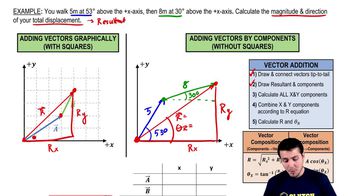
Vector Addition By Components

Trigonometric Functions

Trigonometric functions, such as sine and cosine, are essential for resolving vector components. For a force at an angle θ, the horizontal component can be found using the cosine function (F_horizontal = F * cos(θ)), while the vertical component uses the sine function (F_vertical = F * sin(θ)). These functions relate the angles of a right triangle to the ratios of its sides.
추천 영상:
가이드 코스
08:30
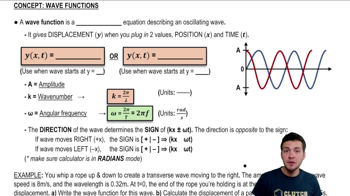
Intro to Wave Functions

Newton's Second Law

Newton's Second Law states that the acceleration of an object is directly proportional to the net force acting on it and inversely proportional to its mass. While this question focuses on force components, understanding this law is crucial for analyzing how the applied forces affect the motion of the suitcase and Kami's overall movement.
추천 영상:
가이드 코스
06:54
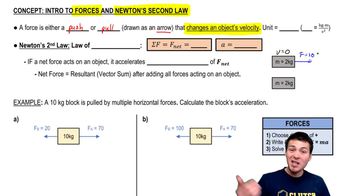
Intro to Forces & Newton's Second Law
관련 실천
교과서 질문

Tom is climbing a 3.0-m-long ladder that leans against a vertical wall, contacting the wall 2.5 m above the ground. His weight of 680 N is a vector pointing vertically downward. (Weight is measured in newtons, abbreviated N.) What are the components of Tom's weight parallel and perpendicular to the ladder?

2345
views
교과서 질문

A jet plane taking off from an aircraft carrier has acceleration a = ( 15 m/s², 22° above horizontal). What are the horizontal and vertical components of the jet's acceleration?

2503
views
교과서 질문

Jack and Jill ran up the hill at 3.0 m/s. The horizontal component of Jill's velocity vector was 2.5 m/s. What was the vertical component of Jill's velocity?

1936
views
교과서 질문

Jack and Jill ran up the hill at 3.0 m/s. The horizontal component of Jill's velocity vector was 2.5 m/s. What was the angle of the hill?

1882
views
교과서 질문

Your neighbor Paul has rented a truck with a loading ramp. The ramp is tilted upward at 25°, and Paul is pulling a large crate up the ramp with a rope that angles 10° above the ramp. If Paul pulls with a force of 550 N, what are the horizontal and vertical components of his force? (Force is measured in newtons, abbreviated N.)

2379
views
교과서 질문

You are fixing the roof of your house when a hammer breaks loose and slides down. The roof makes an angle of 35° with the horizontal, and the hammer is moving at 4.5 m/s when it reaches the edge. What are the horizontal and vertical components of the hammer's velocity just as it leaves the roof?

2187
views