Ch 03: Vectors and Coordinate Systems
Knight Calc - Physics for Scientists and Engineers 5th Edition
Knight Calc5th EditionPhysics for Scientists and EngineersISBN: 9780137344796당신이 사용하는 게 아니라요?교과서 변경
3장, 문제 29a

While vacationing in the mountains you do some hiking. In the morning, your displacement is Smorning=(2000m,east)+(3000m,north)+(200m,vertical)\(\mathbf{S}\)_{morning} = (2000 \, \(\text{m}\), \(\text{east}\)) + (3000 \, \(\text{m}\), \(\text{north}\)) + (200 \, \(\text{m}\), \(\text{vertical}\)). Continuing on after lunch, your displacement is Safternoon=(1500m,west)+(2000m,north)(300m,vertical)\(\mathbf{S}\)_{afternoon} = (1500 \, \(\text{m}\), \(\text{west}\)) + (2000 \, \(\text{m}\), \(\text{north}\)) - (300 \, \(\text{m}\), \(\text{vertical}\)). At the end of the hike, how much higher or lower are you compared to your starting point?

검증된 단계별 안내
1
Step 1: Identify the vertical components of the morning and afternoon displacements. From the problem, the vertical component of the morning displacement is 200 m (upward), and the vertical component of the afternoon displacement is -300 m (downward).
Step 2: Add the vertical components of the morning and afternoon displacements to determine the net vertical displacement. Use the equation: Sᵥₑᵣₜᵢ𝚌ₐₗ = Sₘₒᵣₙᵢₙ₉ᵥₑᵣₜᵢ𝚌ₐₗ + Sₐբₜₑᵣₙₒₒₙᵥₑᵣₜᵢ𝚌ₐₗ.
Step 3: Substitute the values into the equation: Sᵥₑᵣₜᵢ𝚌ₐₗ = 200 m + (-300 m).
Step 4: Simplify the expression to find the net vertical displacement. This will tell you how much higher or lower you are compared to your starting point.
Step 5: Interpret the result. If the net vertical displacement is positive, you are higher than your starting point. If it is negative, you are lower than your starting point.

비슷한 문제에 대한 검증된 영상 답변:

이 영상 해법은 위 문제에 도움이 된다고 튜터들이 추천한 것입니다.
영상 길이:
2m
도움이 되었나요?

주요 개념

질문에 올바르게 답하기 위해 반드시 이해해야 하는 핵심 개념들은 다음과 같습니다.

Displacement

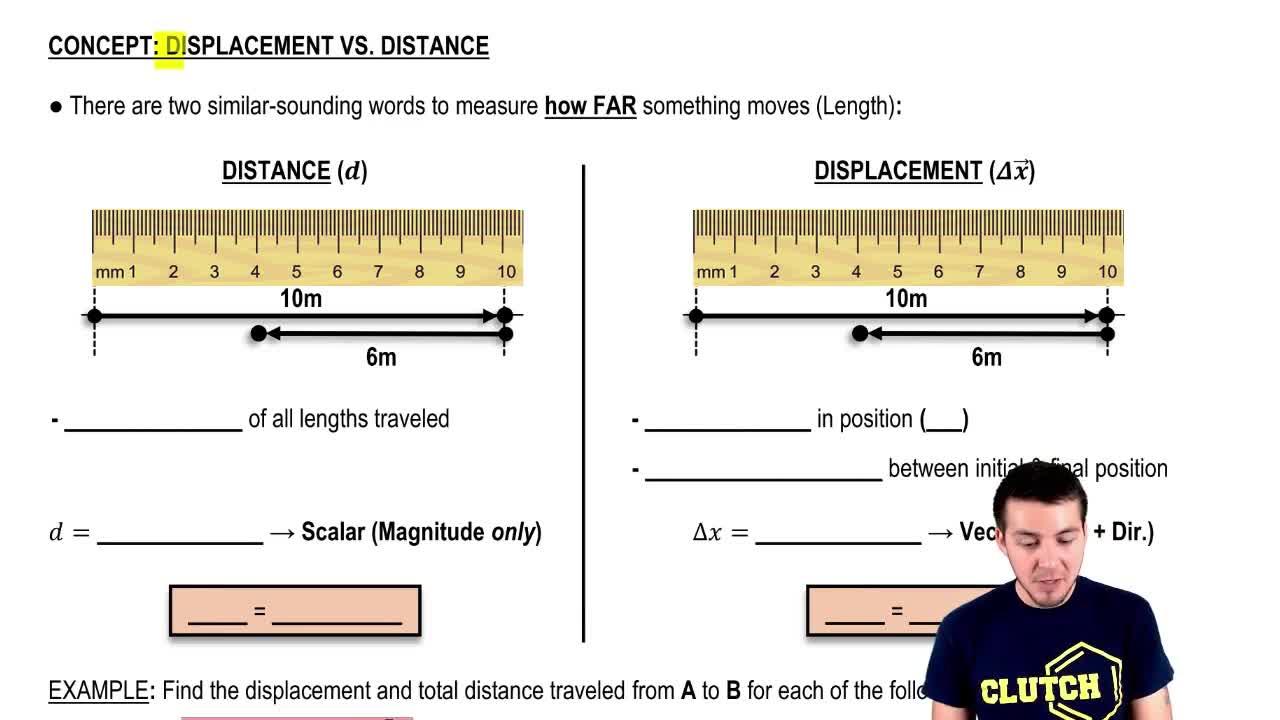
Displacement is a vector quantity that refers to the change in position of an object. It is defined as the shortest distance from the initial to the final position, taking into account the direction. In this context, displacement is expressed in terms of its components in the east-west, north-south, and vertical directions, allowing for a comprehensive understanding of the overall movement.
추천 영상:
가이드 코스
06:13
Displacement vs. Distance

Vector Addition

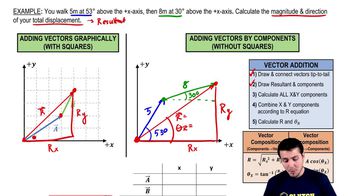
Vector addition is the process of combining two or more vectors to determine a resultant vector. This involves adding the corresponding components of the vectors in each direction. In the given problem, the total displacement for both the morning and afternoon hikes must be calculated by summing their respective components to find the overall change in position.
추천 영상:
가이드 코스
07:30
Vector Addition By Components

Vertical Displacement

Vertical displacement refers specifically to the change in height of an object relative to a reference point, typically the ground. It is crucial for determining how much higher or lower one is compared to the starting point. In this scenario, calculating the vertical displacement involves summing the vertical components from both the morning and afternoon hikes to assess the overall elevation change.
추천 영상:
가이드 코스
06:13
Displacement vs. Distance
관련 실천
교과서 질문

Find a vector that points in the same direction as the vector ( î + ĵ ) and whose magnitude is 1.

3475
views

교과서 질문

Ruth sets out to visit her friend Ward, who lives 50 mi north and 100 mi east of her. She starts by driving east, but after 30 mi she comes to a detour that takes her 15 mi south before going east again. She then drives east for 8 mi and runs out of gas, so Ward flies there in his small plane to get her. What is Ward's displacement vector? Give your answer (a) in component form, using a coordinate system in which the y-axis points north, and (b) as a magnitude and direction.

2469
views
교과서 질문

While vacationing in the mountains you do some hiking. In the morning, your displacement is Smorning=(2000m,east)+(3000m,north)+(200m,vertical)\(\mathbf{S}\)_{morning} = (2000 \, \(\text{m}\), \(\text{east}\)) + (3000 \, \(\text{m}\), \(\text{north}\)) + (200 \, \(\text{m}\), \(\text{vertical}\)). Continuing on after lunch, your displacement is Safternoon=(1500m,west)+(2000m,north)(300m,vertical)\(\mathbf{S}\)_{afternoon} = (1500 \, \(\text{m}\), \(\text{west}\)) + (2000 \, \(\text{m}\), \(\text{north}\)) - (300 \, \(\text{m}\), \(\text{vertical}\)). What is the magnitude of your net displacement for the day?

1405
views
교과서 질문

Trevon drives with velocity v1 = (55î - 10ĵ) mph for 1.0 h, then v2 = (20î + 50ĵ) mph for 2.0 h. What is Trevon's displacement? Write your answer in component form using unit vectors.

2593
views
교과서 질문

The minute hand on a watch is 2.0 cm in length. What is the displacement vector of the tip of the minute hand in each case? Use a coordinate system in which the y-axis points toward the 12 on the watch face. From 8:00 to 8:20 a.m.

1765
views
교과서 질문

The minute hand on a watch is 2.0 cm in length. What is the displacement vector of the tip of the minute hand in each case? Use a coordinate system in which the y-axis points toward the 12 on the watch face. From 8:00 to 9:00 a.m.

1093
views