Ch 04: Kinematics in Two Dimensions
Knight Calc - Physics for Scientists and Engineers 5th Edition
Knight Calc5th EditionPhysics for Scientists and EngineersISBN: 9780137344796당신이 사용하는 게 아니라요?교과서 변경
4장, 문제 73b

The angular velocity of a process control motor is ω = ( 20 ─ ½ t² ) rad/s, where t is in seconds. Through what angle does the motor turn between t = 0 s and the instant at which it reverses direction?

검증된 단계별 안내
1
Step 1: Understand the problem. The angular velocity ω is given as a function of time: ω = 20 - (1/2)t² rad/s. The motor reverses direction when ω = 0. To find the angle θ turned by the motor, we need to integrate the angular velocity over the time interval from t = 0 to the time when ω = 0.
Step 2: Determine the time at which the motor reverses direction. Set ω = 0 and solve for t: 0 = 20 - (1/2)t². Rearrange the equation to isolate t²: t² = 40. Solve for t: t = √40 seconds.
Step 3: Write the expression for the angle θ turned by the motor. The angle θ is the integral of angular velocity ω with respect to time: θ = ∫ω dt. Substitute ω = 20 - (1/2)t² into the integral: θ = ∫(20 - (1/2)t²) dt.
Step 4: Perform the integration. Break the integral into two parts: θ = ∫20 dt - ∫(1/2)t² dt. The first term integrates to 20t, and the second term integrates to -(1/6)t³. Combine these results: θ = 20t - (1/6)t³.
Step 5: Evaluate θ over the interval from t = 0 to t = √40. Substitute the limits of integration into the expression for θ: θ = [20(√40) - (1/6)(√40)³] - [20(0) - (1/6)(0)³]. Simplify the expression to find the total angle turned by the motor.

비슷한 문제에 대한 검증된 영상 답변:

이 영상 해법은 위 문제에 도움이 된다고 튜터들이 추천한 것입니다.
영상 길이:
2m
도움이 되었나요?

주요 개념

질문에 올바르게 답하기 위해 반드시 이해해야 하는 핵심 개념들은 다음과 같습니다.

Angular Velocity

Angular velocity (ω) is a measure of how quickly an object rotates around an axis, expressed in radians per second. In this context, the angular velocity of the motor is given as a function of time, indicating that it changes as time progresses. Understanding angular velocity is crucial for determining how the motor's speed varies and for calculating the total angle turned over a specific time interval.
추천 영상:
가이드 코스
06:18
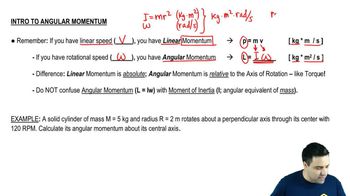
Intro to Angular Momentum

Angular Displacement

Angular displacement refers to the angle through which an object has rotated about a specific axis, measured in radians. To find the total angle the motor turns, we need to integrate the angular velocity function over the time interval from t = 0 s to the time when the motor reverses direction. This concept is essential for connecting the motor's changing speed to the total angle it covers.
추천 영상:
가이드 코스
14:03
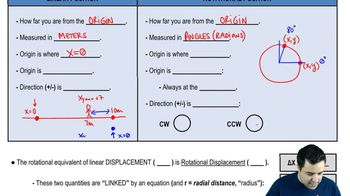
Rotational Position & Displacement

Reversal of Direction

The reversal of direction in a rotating object occurs when its angular velocity changes sign, indicating a transition from clockwise to counterclockwise rotation or vice versa. In this problem, we need to determine the time at which the angular velocity becomes zero (ω = 0) to find when the motor reverses direction. This point is critical for calculating the angle turned during the specified time interval.
추천 영상:
가이드 코스
09:49
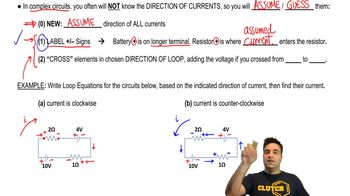
Direction of Current in Loop Equations
관련 실천
교과서 질문

A 25 g steel ball is attached to the top of a 24-cm-diameter vertical wheel. Starting from rest, the wheel accelerates at 470 rad/s². The ball is released after ¾ of a revolution. How high does it go above the center of the wheel?

2111
views

교과서 질문

A 6.0-cm-diameter gear rotates with angular velocity ω = ( 20 ─ ½ t² ) rad/s where t is in seconds. At t = 4.0 s, what are: The tangential acceleration of a tooth on the gear?

1489
views
교과서 질문

A painted tooth on a spinning gear has angular position θ = (6.0 rad/s⁴)t⁴. What is the tooth's angular acceleration at the end of 10 revolutions?

1935
views
교과서 질문

The angular velocity of a process control motor is ω = ( 20 - ½ t² ) rad/s, where t is in seconds. At what time does the motor reverse direction?

1471
views
교과서 질문

A 6.0-cm-diameter gear rotates with angular velocity ω = ( 20 ─ ½ t² ) rad/s where t is in seconds. At t = 4.0 s, what are: The gear's angular acceleration?

1494
views
교과서 질문

Flywheels—rapidly rotating disks—are widely used in industry for storing energy. They are spun up slowly when extra energy is available, then decelerate quickly when needed to supply a boost of energy. A 20-cm-diameter rotor made of advanced materials can spin at 100,000 rpm. b. Suppose the rotor's angular velocity decreases by 40% over 30 s as it supplies energy. What is the magnitude of the rotor's angular acceleration? Assume that the angular acceleration is constant.

1991
views