Ch 06: Dynamics I: Motion Along a Line
Knight Calc - Physics for Scientists and Engineers 5th Edition
Knight Calc5th EditionPhysics for Scientists and EngineersISBN: 9780137344796당신이 사용하는 게 아니라요?교과서 변경
6장, 문제 21a

A 20,000 kg rocket has a rocket motor that generates 3.0 x 10⁵ N of thrust. Assume no air resistance. What is the rocket's initial upward acceleration?

검증된 단계별 안내
1
Step 1: Identify the forces acting on the rocket. The rocket experiences two forces: the upward thrust generated by the motor (3.0 × 10⁵ N) and the downward gravitational force (weight), which is calculated as the product of the rocket's mass (20,000 kg) and the acceleration due to gravity (g = 9.8 m/s²).
Step 2: Calculate the gravitational force acting on the rocket using the formula: F=mg, where m is the mass of the rocket and g is the acceleration due to gravity.
Step 3: Determine the net force acting on the rocket. The net force is the difference between the upward thrust and the downward gravitational force: Fnet=Fthrust-Fgravity.
Step 4: Use Newton's Second Law of Motion to calculate the rocket's initial upward acceleration. The formula is: a=Fnetm, where a is the acceleration, Fnet is the net force, and m is the mass of the rocket.
Step 5: Substitute the values for the net force and mass into the formula to find the initial upward acceleration. Ensure all units are consistent (N for force, kg for mass, and m/s² for acceleration).

비슷한 문제에 대한 검증된 영상 답변:

이 영상 해법은 위 문제에 도움이 된다고 튜터들이 추천한 것입니다.
영상 길이:
3m
도움이 되었나요?

주요 개념

질문에 올바르게 답하기 위해 반드시 이해해야 하는 핵심 개념들은 다음과 같습니다.

Newton's Second Law of Motion

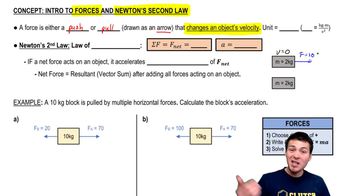
Newton's Second Law states that the acceleration of an object is directly proportional to the net force acting on it and inversely proportional to its mass. This relationship is expressed by the formula F = ma, where F is the net force, m is the mass, and a is the acceleration. In the context of the rocket, the thrust generated by the motor provides the net force that will determine the rocket's acceleration.
추천 영상:
06:54
Intro to Forces & Newton's Second Law

Weight of the Rocket

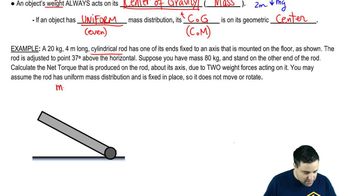
The weight of an object is the force exerted on it due to gravity, calculated as the product of its mass and the acceleration due to gravity (approximately 9.81 m/s² on Earth). For the rocket, its weight can be calculated using the formula W = mg, where W is weight, m is mass, and g is the acceleration due to gravity. This weight acts downward and must be considered when calculating the net force acting on the rocket.
추천 영상:
10:19
Torque Due to Weight

Net Force

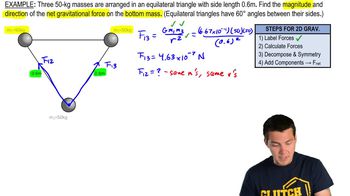
Net force is the total force acting on an object after all the forces are combined. In the case of the rocket, the net force is the difference between the thrust produced by the rocket motor and the weight of the rocket. This net force is what ultimately determines the rocket's acceleration, as per Newton's Second Law, allowing us to calculate how quickly the rocket will ascend.
추천 영상:
06:28
Finding Net Forces in 2D Gravitation