Ch 06: Dynamics I: Motion Along a Line
Knight Calc - Physics for Scientists and Engineers 5th Edition
Knight Calc5th EditionPhysics for Scientists and EngineersISBN: 9780137344796당신이 사용하는 게 아니라요?교과서 변경
6장, 문제 60

A particle of mass m moving along the x-axis experiences the net force Fₓ = ct, where c is a constant. The particle has velocity v₀ₓ at t = 0. Find an algebraic expression for the particle's velocity vₓ at a later time t.

검증된 단계별 안내
1
Start by recalling Newton's second law of motion, which states that the net force acting on an object is equal to the rate of change of its momentum. For a particle of constant mass m, this simplifies to: F_x = m \(\frac{dv_x}{dt}\).
Substitute the given force F_x = ct into the equation: m \(\frac{dv_x}{dt}\) = ct. Rearrange to isolate \(\frac{dv_x}{dt}\): \(\frac{dv_x}{dt}\) = \(\frac{ct}{m}\).
Integrate both sides with respect to time to find the velocity v_x. The left-hand side becomes \(\int\) dv_x, and the right-hand side becomes \(\int\) \(\frac{ct}{m}\) dt: v_x = \(\int\) \(\frac{ct}{m}\) dt.
Perform the integration on the right-hand side. Since c and m are constants, they can be factored out: v_x = \(\frac{c}{m}\) \(\int\) t dt. The integral of t is \(\frac{t^2}{2}\), so: v_x = \(\frac{c}{m}\) \(\cdot\) \(\frac{t^2}{2}\) + C, where C is the constant of integration.
Determine the constant of integration C using the initial condition. At t = 0, the velocity is v_{0x}. Substituting these values into the equation: v_{0x} = \(\frac{c}{m}\) \(\cdot\) \(\frac{(0)^2}{2}\) + C, we find C = v_{0x}. Thus, the final expression for the velocity is: v_x = \(\frac{c}{2m}\) t^2 + v_{0x}.

비슷한 문제에 대한 검증된 영상 답변:

이 영상 해법은 위 문제에 도움이 된다고 튜터들이 추천한 것입니다.
영상 길이:
4m
도움이 되었나요?

주요 개념

질문에 올바르게 답하기 위해 반드시 이해해야 하는 핵심 개념들은 다음과 같습니다.

Newton's Second Law of Motion

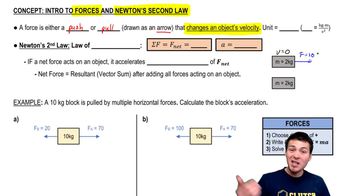
Newton's Second Law states that the acceleration of an object is directly proportional to the net force acting on it and inversely proportional to its mass. This relationship is expressed as F = ma, where F is the net force, m is the mass, and a is the acceleration. Understanding this law is crucial for analyzing how forces affect the motion of a particle.
추천 영상:
가이드 코스
06:54
Intro to Forces & Newton's Second Law

Kinematics and Velocity

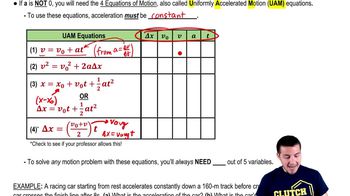
Kinematics is the branch of mechanics that describes the motion of objects without considering the forces that cause the motion. Velocity is defined as the rate of change of displacement with respect to time. In this context, knowing how to relate acceleration to changes in velocity over time is essential for deriving the particle's velocity from the given force.
추천 영상:
가이드 코스
08:25
Kinematics Equations

Integration in Physics

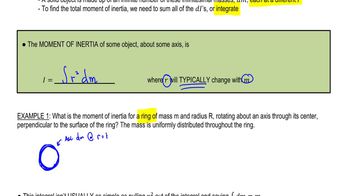
Integration is a mathematical process used to find the total accumulation of a quantity, such as velocity from acceleration. In physics, when a force leads to acceleration, integrating the acceleration function over time provides the change in velocity. This concept is vital for solving the problem, as it allows us to derive the velocity expression from the given force function.
추천 영상:
가이드 코스
11:43
Finding Moment Of Inertia By Integrating