Ch 06: Dynamics I: Motion Along a Line
Knight Calc - Physics for Scientists and Engineers 5th Edition
Knight Calc5th EditionPhysics for Scientists and EngineersISBN: 9780137344796당신이 사용하는 게 아니라요?교과서 변경
6장, 문제 35a

So-called volcanic 'ash' is actually finely pulverized rock blown high into the atmosphere. A typical ash particle is a 50-μm-diameter piece of silica with a density of 2400 kg/m3. How long would it take this ash particle to fall from a height of 5.0 km in vacuum?

검증된 단계별 안내
1
Determine the mass of the ash particle using its volume and density. The volume of a sphere is given by \( V = \frac{4}{3} \pi r^3 \), where \( r \) is the radius of the particle. The radius is half the diameter, so \( r = \frac{50 \times 10^{-6}}{2} \) meters. Then, calculate the mass using \( m = \rho V \), where \( \rho \) is the density (2400 kg/m^3).
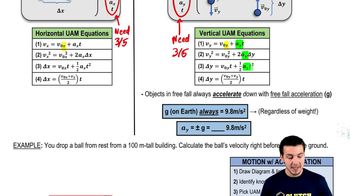
In a vacuum, the only force acting on the particle is gravity. The acceleration due to gravity is \( g = 9.8 \ \text{m/s}^2 \). The motion of the particle can be treated as free fall under constant acceleration.
Use the kinematic equation \( h = \frac{1}{2} g t^2 \) to solve for the time \( t \). Here, \( h \) is the height (5.0 km or 5000 m), \( g \) is the acceleration due to gravity, and \( t \) is the time to fall.
Rearrange the equation to solve for \( t \): \( t = \sqrt{\frac{2h}{g}} \). Substitute \( h = 5000 \ \text{m} \) and \( g = 9.8 \ \text{m/s}^2 \) into the equation.
Perform the calculation to find the time \( t \). This will give the time it takes for the ash particle to fall from a height of 5.0 km in a vacuum.

비슷한 문제에 대한 검증된 영상 답변:

이 영상 해법은 위 문제에 도움이 된다고 튜터들이 추천한 것입니다.
영상 길이:
3m
도움이 되었나요?

주요 개념

질문에 올바르게 답하기 위해 반드시 이해해야 하는 핵심 개념들은 다음과 같습니다.

Free Fall

Free fall refers to the motion of an object under the influence of gravity alone, without any air resistance. In a vacuum, all objects fall at the same rate regardless of their mass, which is approximately 9.81 m/s² on Earth. This principle allows us to calculate the time it takes for an object to fall from a certain height using the equations of motion.
추천 영상:
가이드 코스
08:36
Vertical Motion & Free Fall

Kinematic Equations

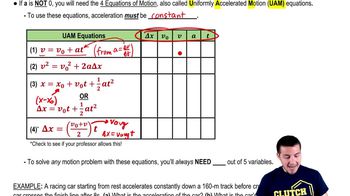
Kinematic equations describe the motion of objects under constant acceleration. For free fall, the relevant equation is h = 0.5 * g * t², where h is the height, g is the acceleration due to gravity, and t is the time of fall. This equation can be rearranged to solve for time when the height and acceleration are known.
추천 영상:
가이드 코스
08:25
Kinematics Equations

Density and Volume

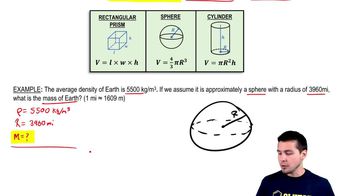
Density is defined as mass per unit volume and is crucial for understanding the properties of materials. In this context, the density of the ash particle (2400 kg/m³) helps to identify its mass if the volume is known. However, in a vacuum scenario, the density does not affect the fall time, as all objects fall at the same rate regardless of their mass or density.
추천 영상:
가이드 코스
04:33
Problems with Mass, Volume, & Density