
Ch 06: Dynamics I: Motion Along a Line
Knight Calc - Physics for Scientists and Engineers 5th Edition
Knight Calc5th EditionPhysics for Scientists and EngineersISBN: 9780137344796당신이 사용하는 게 아니라요?교과서 변경
6장, 문제 9

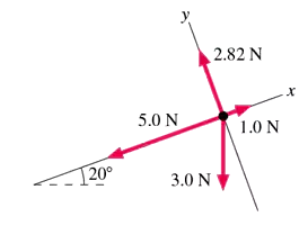
The forces in FIGURE EX6.9 act on a 2.0 kg object. What are the values of ax and ay, the x- and y-components of the object's acceleration?

검증된 단계별 안내
1
Step 1: Identify the forces acting on the object. From the diagram, the forces are: 18 N upward, 10.7 N to the right, 10 N downward along the incline, and 12.3 N downward perpendicular to the incline. The incline is at an angle θ = 30°.
Step 2: Resolve the forces into components along the x-axis (parallel to the incline) and y-axis (perpendicular to the incline). For forces at an angle, use trigonometric functions: \( F_x = F \cos \theta \) and \( F_y = F \sin \theta \).
Step 3: Sum up the forces along the x-axis to find the net force \( F_{net,x} \). Include contributions from the 10.7 N force, the x-component of the 12.3 N force, and the x-component of the 10 N force. Use \( F_{net,x} = F_{10.7} + F_{12.3,x} - F_{10,x} \).
Step 4: Sum up the forces along the y-axis to find the net force \( F_{net,y} \). Include contributions from the 18 N force, the y-component of the 12.3 N force, and the y-component of the 10 N force. Use \( F_{net,y} = F_{18} - F_{12.3,y} - F_{10,y} \).
Step 5: Use Newton's second law \( F = ma \) to calculate the acceleration components \( a_x \) and \( a_y \). Divide the net forces by the mass of the object (2.0 kg): \( a_x = \frac{F_{net,x}}{m} \) and \( a_y = \frac{F_{net,y}}{m} \).

비슷한 문제에 대한 검증된 영상 답변:

이 영상 해법은 위 문제에 도움이 된다고 튜터들이 추천한 것입니다.
영상 길이:
7m
도움이 되었나요?

주요 개념

질문에 올바르게 답하기 위해 반드시 이해해야 하는 핵심 개념들은 다음과 같습니다.

Newton's Second Law of Motion

Newton's Second Law states that the acceleration of an object is directly proportional to the net force acting on it and inversely proportional to its mass. This relationship is expressed by the equation F = ma, where F is the net force, m is the mass, and a is the acceleration. In this problem, understanding this law is crucial for calculating the acceleration components of the object based on the forces acting on it.
추천 영상:
가이드 코스
06:54
Intro to Forces & Newton's Second Law

Vector Resolution

Vector resolution involves breaking down a vector into its components along specified axes, typically the x and y axes. This is essential in physics to analyze forces acting at angles, as seen in the diagram. By resolving the forces into their components, we can apply Newton's Second Law to find the acceleration in each direction, which is necessary for solving the problem.
추천 영상:
가이드 코스
06:44
Adding 3 Vectors in Unit Vector Notation

Free Body Diagram (FBD)

A Free Body Diagram is a graphical representation that shows all the forces acting on an object. In this case, the FBD helps visualize the forces acting on the 2.0 kg object on the incline, including gravitational force, normal force, and applied forces. Analyzing the FBD is crucial for determining the net force and subsequently the acceleration components in the x and y directions.
추천 영상:
가이드 코스
08:42
Free-Body Diagrams