
Ch 07: Newton's Third Law
Knight Calc - Physics for Scientists and Engineers 5th Edition
Knight Calc5th EditionPhysics for Scientists and EngineersISBN: 9780137344796당신이 사용하는 게 아니라요?교과서 변경
7장, 문제 19

A 500 kg air conditioner sits on the flat roof of a building. The coefficient of static friction between the roof and the air conditioner is 0.90. A massless rope attached to the air conditioner passes over a massless, frictionless pulley at the edge of the roof. In an effort to drag the air conditioner to the edge of the roof, four 100 kg students hang from the free end of the rope, but the air conditioner refuses to budge. What is the magnitude of the rope tension at the point where it is attached to the air conditioner?

검증된 단계별 안내
1
Step 1: Begin by identifying the forces acting on the air conditioner. The air conditioner is stationary, so the static friction force is preventing it from moving. The maximum static friction force is given by the formula: fmax = μNs, where μ is the coefficient of static friction and Ns is the normal force.
Step 2: Calculate the normal force acting on the air conditioner. Since the air conditioner is on a flat roof, the normal force is equal to its weight. The weight is given by Ns = mg, where m is the mass of the air conditioner (500 kg) and g is the acceleration due to gravity (approximately 9.8 m/s²).
Step 3: Determine the maximum static friction force using the coefficient of static friction (μ = 0.90) and the normal force calculated in Step 2. Substitute these values into the formula fmax = μNs.
Step 4: Analyze the forces exerted by the students hanging from the rope. The total weight of the students is given by W = mg, where m is the combined mass of the students (4 × 100 kg = 400 kg) and g is the acceleration due to gravity. Calculate this total weight.
Step 5: Compare the tension in the rope (equal to the weight of the students) to the maximum static friction force. Since the air conditioner does not move, the tension in the rope must be less than or equal to the maximum static friction force. The magnitude of the rope tension at the point where it is attached to the air conditioner is equal to the weight of the students hanging from the rope.

비슷한 문제에 대한 검증된 영상 답변:

이 영상 해법은 위 문제에 도움이 된다고 튜터들이 추천한 것입니다.
영상 길이:
4m

주요 개념

질문에 올바르게 답하기 위해 반드시 이해해야 하는 핵심 개념들은 다음과 같습니다.

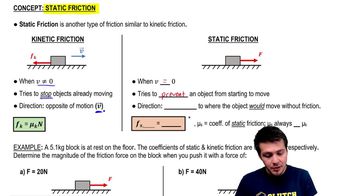
Static Friction

Static friction is the force that resists the initiation of sliding motion between two surfaces in contact. It is characterized by a coefficient of static friction, which quantifies the maximum frictional force before movement occurs. In this scenario, the static friction between the air conditioner and the roof must be overcome by the tension in the rope for the air conditioner to move.
추천 영상:
가이드 코스
08:11
Static Friction & Equilibrium

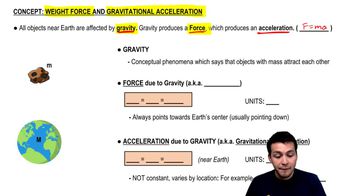
Weight and Gravitational Force

Weight is the force exerted by gravity on an object, calculated as the product of mass and the acceleration due to gravity (approximately 9.81 m/s² on Earth). In this case, the total weight of the four students hanging from the rope creates a downward force that contributes to the tension in the rope. Understanding how weight affects tension is crucial for analyzing the forces acting on the air conditioner.
추천 영상:
가이드 코스
07:32
Weight Force & Gravitational Acceleration

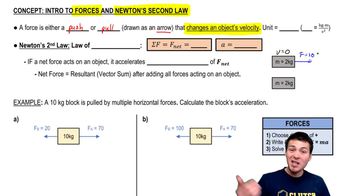
Newton's Second Law of Motion

Newton's Second Law states that the acceleration of an object is directly proportional to the net force acting on it and inversely proportional to its mass (F = ma). This principle helps in understanding the balance of forces in the system, where the tension in the rope must equal the static friction force to prevent the air conditioner from moving. Analyzing these forces allows us to determine the conditions under which the air conditioner will start to slide.
추천 영상:
가이드 코스
06:54
Intro to Forces & Newton's Second Law
관련 실천
교과서 질문

A mobile at the art museum has a 2.0 kg steel cat and a 4.0 kg steel dog suspended from a lightweight cable, as shown in FIGURE EX7.21. It is found that θ1\(\theta\)_1 = 20° when the center rope is adjusted to be perfectly horizontal. What are the tension and the angle of rope 3?

3886
views
1
rank
1
comments
교과서 질문

A 2.0-m-long, 500 g rope pulls a 10 kg block of ice across a horizontal, frictionless surface. The block accelerates at 2.0 m/s2. How much force pulls forward on he rope? Assume that the rope is perfectly horizontal.

2108
views
교과서 질문

The 100 kg block in FIGURE EX7.24 takes 6.0 s to reach the floor after being released from rest. What is the mass of the block on the left? The pulley is massless and frictionless.

3383
views
1
rank
교과서 질문

The sled dog in FIGURE EX7.15 drags sleds A and B across the snow. The coefficient of friction between the sleds and the snow is 0.10. If the tension in rope 1 is 150 N, what is the tension in rope 2?

572
views
교과서 질문

FIGURE EX7.17 shows two 1.0 kg blocks connected by a rope. A second rope hangs beneath the lower block. Both ropes have a mass of 250 g. The entire assembly is accelerated upward at 3.0 m/s2 by force F. What is the tension at the top end of rope 1?

2896
views
교과서 질문

The 1.0 kg block in FIGURE EX7.23 is tied to the wall with a rope. It sits on top of the 2.0 kg block. The lower block is pulled to the right with a tension force of 20 N. The coefficient of kinetic friction at both the lower and upper surfaces of the 2.0 kg block is μk = 0.40. What is the tension in the rope attached to the wall?

474
views